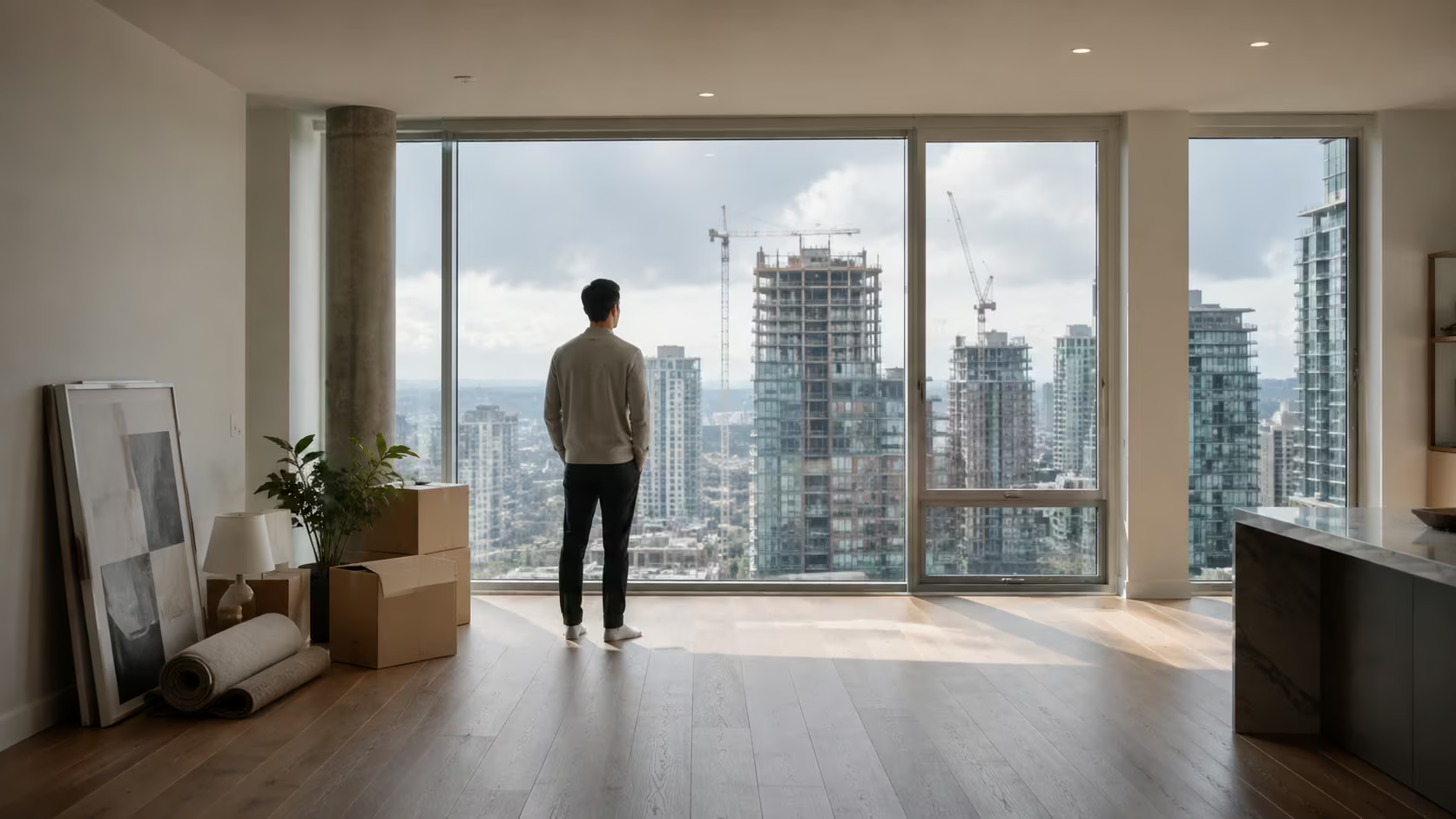
On June 18, Prime Minister Mark Carney stood in Vancouver's River District, flanked by unsold condo towers where two-bedroom units were listed for close to $1.1 million, and announced a plan to unfreeze BC's housing market. Beside him was Premier David Eby. Together they outlined a $3.2 billion federal-provincial package with two main components: cut development charges in half for multi-unit housing in priority communities, and convert more than 2,200 vacant condos into affordable homes.
Industry reaction has been mixed. Some see the plan as a lifeline. Others warn it could become a developer bailout unless purchase terms are made clear. Most observers on both sides agree on one thing: the concept has merit, but the details aren't there yet.
That last part is the honest summary of where this stands.
What the Announcement Actually Commits To
The $3.2 billion breaks down as $1.6 billion from the federal government matched dollar-for-dollar by the province, spread over 10 years. The money flows through the Build Communities Strong Fund and is meant to compensate municipalities for the revenue they would lose by cutting development cost charges, the fees developers pay to fund roads, sewers, water systems, and other infrastructure tied to new construction.
The target reduction is up to 50 percent on multi-unit housing in what the announcement calls "priority communities." In practical terms, the government says this could translate to savings of up to $40,000 per unit. That number matters. CMHC data published last December showed that development fees in BC can add tens of thousands of dollars to the cost of every new home before a single trade is on site. In Kelowna, the Canadian Home Builders' Association estimates that municipal taxes, fees, and charges now account for roughly 30 percent of the total cost of a new home.
$40,000 per unit is real money. Whether buyers actually see it depends on whether developers pass the savings through in pricing rather than rebuilding margins, which is the same tension that surfaced when Ontario announced its own $8.8 billion federal-provincial charge reduction deal on March 30. The mechanism is sound. The distribution is not guaranteed.
The second piece is the condo conversion plan. Through Build Canada Homes and BC Housing, the two governments will use what they're calling "innovative financing tools" to convert more than 2,200 vacant completed condos in priority growth areas into affordable housing. The government frames this as one of the fastest ways to increase affordable supply: the units are already built, already permitted, already standing. Rather than waiting years for new construction to deliver, the idea is to put people into homes that exist right now.
Why There Are That Many Empty Condos
The vacancy problem is real and getting worse. CMHC data from May 2026 shows 4,376 completed and unabsorbed condo apartments in Metro Vancouver, up 76 percent from a year earlier. The Greater Toronto-Hamilton Area recorded a similar pattern, with 4,295 unsold completed condo units in Q1 2026, more than double the figure from the same quarter in 2025.
A major part of the problem appears to be the pullback in investor demand from the presale market. For years, a significant share of new condo presales in Metro Vancouver went to buyers who intended to rent the units out or flip them near completion. When profitability on those investments collapsed under the weight of higher rates, softer prices, and stricter regulations, investor demand evaporated. Developers who had already broken ground or completed construction were left holding finished product with no buyers. Selling at deep discounts can create serious financing and valuation problems for developers and lenders, so the units sit.
Carney said at the announcement that these empty condos "disincentivize new construction, unsettle lenders and investors, and create a housing market that, in effect, feels frozen." He's not wrong. Stalled inventory signals a broken market to the next wave of projects. Developers looking at current sell-through rates in Metro Vancouver are not starting new towers. If today's project cancellations continue, the supply gap is likely to show up later in the decade, especially around 2028 and 2029, when demand has recovered but supply hasn't.
Converting those 2,200 units takes them off the developer's books and puts people into homes. That logic is defensible.
What's Still Missing
Here's the problem: five days after the announcement, the government has not said how much it will pay per unit, what discount (if any) it will demand from developers, how affordability will be defined going forward, or which communities qualify as "priority."
That gap matters because the price determines whether this is a policy or a subsidy. A back-of-envelope calculation from analysts suggests that 2,200 units purchased at an average of $800,000 each would run to about $1.76 billion. At average prices closer to $1.1 million, the figure approaches $2.5 billion. Neither figure includes holding costs or the eventual cost of running affordable housing programs in those units.
If the government negotiates meaningful discounts and forces developers to take real losses in exchange for liquidity, this looks like a smart market intervention. The government gets affordable units faster than any new build could deliver them. Developers get an exit from inventory that would otherwise sit for years. And the broader market signal improves enough that new projects become viable again.
If the government pays near-market prices, the math flips. Taxpayers fund a floor under developer losses, units that were unaffordable at $1.1 million remain expensive to administer even as "affordable" rentals, and the moral hazard problem becomes very loud. The critique that this rewards poor developer risk management with public money lands squarely in that scenario.
The governments have promised details this fall. Until then, the "bailout vs. policy" debate is noise. Neither side can win it without knowing the purchase price, the discount negotiated, the ownership model, the rent rules, and the definition of affordability. All five are unresolved.
What the DCC Side Gets Right
Setting aside the condo conversion controversy, the development charge reduction is the less contested part of the announcement and arguably the more consequential one for long-term supply.
The charge-cutting model is the same one Ottawa used with Ontario, and the logic holds: fund the infrastructure municipalities would have charged for, remove the upfront cost barrier, and let more projects pencil out economically. The fewer projects that collapse at the financing stage, the more supply reaches the market in three to five years when it's needed.
One complication is that Metro Vancouver's regional district directed a rollback of 2026 development charge increases back to 2025 rates in April, ahead of this federal-provincial deal. That rollback is still pending provincial approval and final board adoption, so current rates remain in place for now. How the two layers interact once both are in force, and whether municipalities further downstream actually reduce charges rather than absorb the federal funding for other priorities, is still being worked out. That's not a trivial detail. Municipal cooperation is what makes or breaks this model.
For communities outside Metro Vancouver, including the Okanagan, the question is whether "priority community" designation reaches here. That's not confirmed. Kelowna's development cost charge burden is real and well-documented. Whether the relief does too remains to be seen.
The Bigger Picture for BC Buyers
The most important thing to understand about this announcement is what it's responding to. BC's new housing construction is collapsing at exactly the wrong time. The projects that should be coming to market in 2028 aren't being started today because the numbers don't work. Cutting charges removes one of the most stubborn cost layers. Converting empty condos buys time in the near term by moving inventory that's already built.
Neither measure is sufficient on its own. The charge reductions need to actually reach buyers. The condo conversions need to be priced properly to be genuine affordable housing rather than market units with a different landlord. And the details, when they come in fall 2026, will determine whether this holds up as serious policy or becomes a cautionary tale about announcement politics.
For buyers in BC right now, the practical impact of this deal is still months away at best. The market is moving on its own terms regardless: prices have softened, inventory is building, and interest rates have come down from their peaks. If the charge reductions do translate to cheaper new construction in 2027 and 2028, that matters for buyers planning ahead.
If you want to understand what the current BC market actually looks like for your situation, whether you're buying now or watching to see how this plays out, our team can walk you through the numbers without the noise. Policy takes time. Real decisions happen faster.
The content of this article is for informational purposes only and should not be considered as financial, legal, or professional advice. Coldwell Banker Horizon Realty makes no representations as to the accuracy, completeness, or suitability of the information provided. Readers are encouraged to consult with qualified professionals regarding their specific real estate, financial, and legal circumstances. The views expressed in this article may not necessarily reflect the views of Coldwell Banker Horizon Realty or its agents. Real estate market conditions and government policies may change, and readers should verify the latest updates with appropriate professionals.