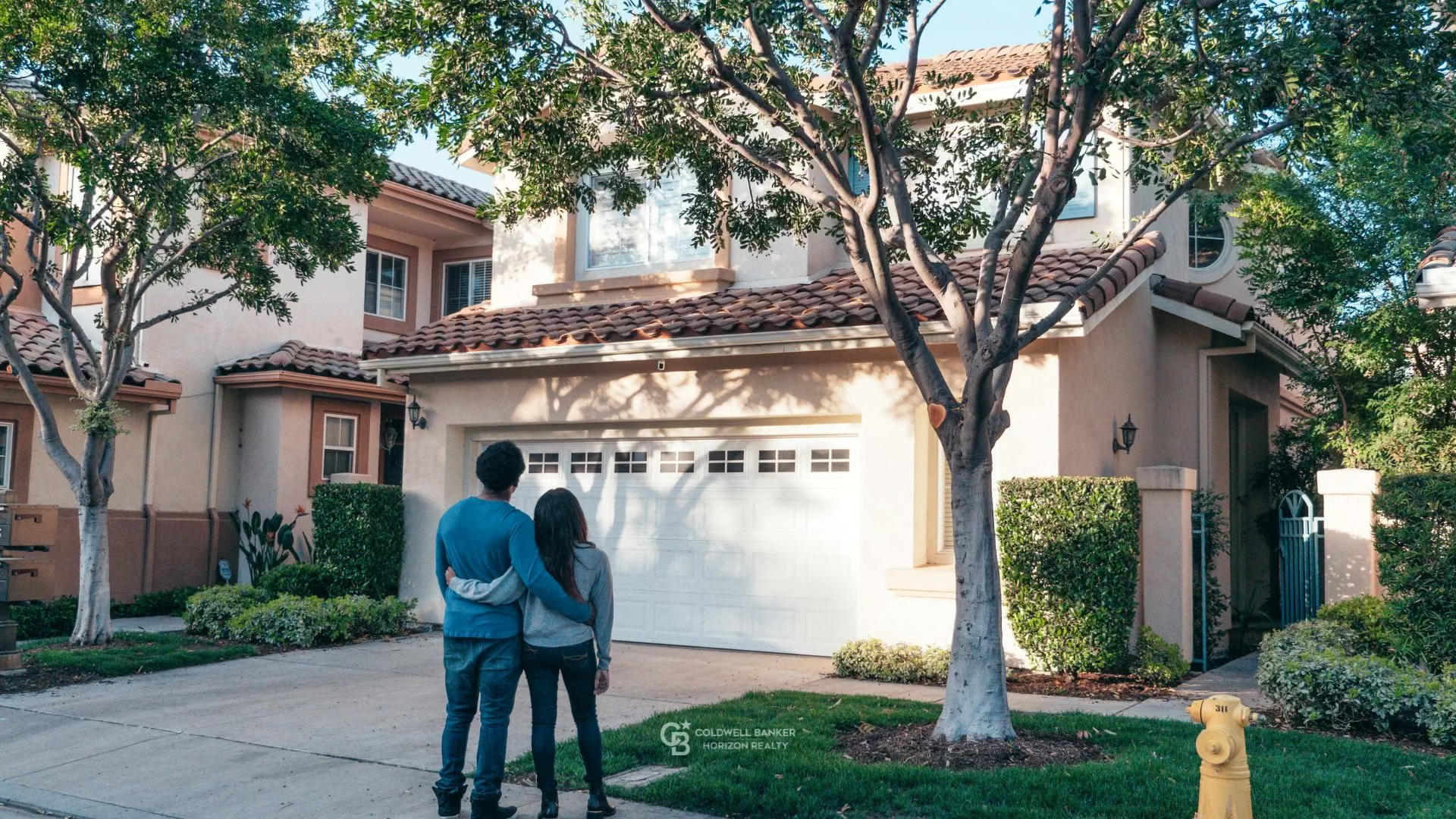
When a young family in Kelowna shops for a new home, they focus on the list price. They run mortgage calculations, stress-test their budget, and wonder if the numbers can work. What they usually don't think about is how much of that sticker price was determined before a single nail was driven, locked in by a layer of government charges that have quietly become one of the most significant affordability barriers in Canadian housing.
Development charges go by different names in different provinces. In BC, they're called Development Cost Charges, or DCCs. The concept is simple enough: a fee collected from developers when new homes are built to help fund the roads, sewers, water mains, parks, and drainage infrastructure that new development requires. In principle, that's fair. Growth should pay for growth. In practice, the numbers have become a serious problem.
What the Charges Are Actually Costing Buyers
A December 2025 study from CMHC put concrete numbers on what development fees add to new home prices across Canada. For a two-bedroom condominium, the charges range from roughly $39,600 in Ottawa to $121,500 in Markham. For single-detached homes, they run from around $125,000 in Pickering to about $180,600 in Toronto. In BC, CMHC's data show Coquitlam at roughly $62,000 per condo unit, the highest in the province, with detached home fees also running into six figures in the highest-cost BC municipalities. Vancouver wasn't included in the study because its fee structure wasn't directly comparable to other cities.
According to the Central Okanagan branch of the Canadian Home Builders' Association, municipal taxes, fees, and charges now make up roughly 30 percent of the cost of a new home in Kelowna. That figure sits alongside land costs, construction costs, and financing. The result is that builders in many markets, including Kelowna, are finding that when banks crunch the numbers on proposed projects, the math simply doesn't work. The price a home would need to sell for to cover all those costs exceeds what buyers can or will pay.
CHBA data show that low-rise development fees climbed by an average of about 33 percent across Canada in just two years, with even steeper jumps in high-cost municipalities in Ontario and BC. In Ontario, the situation has become particularly extreme. Industry groups including OREA and the Missing Middle Institute have argued that development charges in the City of Toronto have increased by orders of magnitude over the past 25 years, far outpacing inflation, and Toronto now ranks as one of the most expensive places in the world to build a new home.
Kelowna Is Not Immune
Kelowna sits in a different position from Toronto or Vancouver. The City proposed a 2.5 percent DCC increase tied to CPI, even as construction inflation and infrastructure costs have risen far faster, leaving the City absorbing a significant share of the gap. The City is actively reviewing its DCC structure and further changes are under discussion in 2025 and 2026.
But the results on the ground are still stark. CHBA-CO data indicate that new single-family home starts in Kelowna fell to roughly 130 in 2025, down from annual averages north of 300 in the early 2020s. Building permit values have followed a similar trajectory, running well below the prior four-year average and declining sharply in some months, with local builders reporting a significant drop in new project launches compared to the 2021 to 2022 period.
The CHBA-CO has been direct about what it's seeing on the ground: small builders, the kind who typically build three to five homes a year, have stopped pulling permits. Some haven't started a project in over two years. The association's open letter to Kelowna's mayor and council in early 2026 described a residential construction sector under extraordinary strain, with builders leaving for Alberta where costs and regulatory conditions are more manageable.
Kelowna's city government pushed back, arguing the slowdown reflects national macroeconomic conditions rather than local policy decisions, and pointing to builders struggling in cities with both higher and lower fee structures than Kelowna. That's a fair point to raise. But the CHBA-CO countered with CMHC data showing that while single-detached building has declined in higher-cost provinces like Ontario and BC, it has grown in lower-fee Prairie provinces such as Saskatchewan and Manitoba. The pattern is hard to dismiss.
The CHBA-CO has also pointed out that Kelowna holds a large DCC reserve in the hundreds of millions of dollars, and has urged council to consider a temporary DCC holiday to jump-start new home construction, something the city has not yet committed to but has indicated it is reviewing.
What Gets Built Instead
One of the persistent criticisms from Kelowna's building community is that municipal policy over the past decade has heavily favoured rental apartment construction over ownership housing. That policy produced real results on the rental side. Kelowna has seen a surge of six-storey apartment buildings across the city, and after peaking above $2,000 for many one-bedrooms in 2025, typical advertised one-bedroom rents have eased to roughly $1,700, as new supply pushed vacancy higher. That's meaningful relief for renters.
But it has done little for the first-time buyer or the young family trying to get into ownership. The new homes that middle-income buyers actually want, detached homes, townhouses, and condominiums priced for families rather than investors, are precisely the segment where construction has collapsed.
This connects to a broader national problem: CMHC estimates Canada needs to build between 430,000 and 480,000 homes per year for the next decade to restore affordability to 2019 levels. The current pace is less than half that. Development charges are one piece of a larger puzzle that also includes slow approvals, labour shortages, construction costs, and a fragmented building industry. But they're a piece that governments at every level have the ability to act on directly.
The federal GST rebate for first-time buyers on new homes, which received Royal Assent on March 13, 2026, removes up to $50,000 in federal tax for eligible buyers on homes up to $1 million. That's a genuine help. But as CHBA-CO noted, while Ottawa has delivered the GST relief, it has not moved ahead on deeper reforms to municipal development charges, despite previously signalling openness to that conversation. One tax is removed while another remains entrenched.
What This Means for Buyers in the Okanagan Right Now
The practical implication for someone shopping for a newly built home in Kelowna or the broader Okanagan is that the price they see is not just a reflection of construction costs and developer profit. A meaningful share of it is government charges, layered in at the municipal, provincial, and sometimes federal level, before a home ever reaches the market.
That doesn't make new construction a bad purchase. For the right buyer, in the right location, at the right price point, ownership is still one of the most reliable wealth-building tools available. But it does mean buyers should understand what they're paying for and why, and sellers of existing homes should understand that reduced new construction supply is one of the factors keeping demand for resale properties from collapsing entirely.
Change is possible. Nova Scotia passed Bill 329 in 2023, introducing a two-year freeze on development charges in Halifax that was later extended, and is set to wind down in late 2026. In Ontario, industry groups and the Toronto Region Board of Trade are urging the province to overhaul its Development Charges Act, including substantial reductions in water and wastewater-related charges in high-cost municipalities. In Kelowna, the active DCC review underway in 2025 and 2026 is worth watching closely.
If you're buying, selling, or trying to understand how construction costs and supply trends are shaping values in your specific corner of the Okanagan, the team at Coldwell Banker Horizon Realty can help you navigate what the numbers actually mean for your situation.
The content of this article is for informational purposes only and should not be considered as financial, legal, or professional advice. Coldwell Banker Horizon Realty makes no representations as to the accuracy, completeness, or suitability of the information provided. Readers are encouraged to consult with qualified professionals regarding their specific real estate, financial, and legal circumstances. The views expressed in this article may not necessarily reflect the views of Coldwell Banker Horizon Realty or its agents. Real estate market conditions and government policies may change, and readers should verify the latest updates with appropriate professionals.