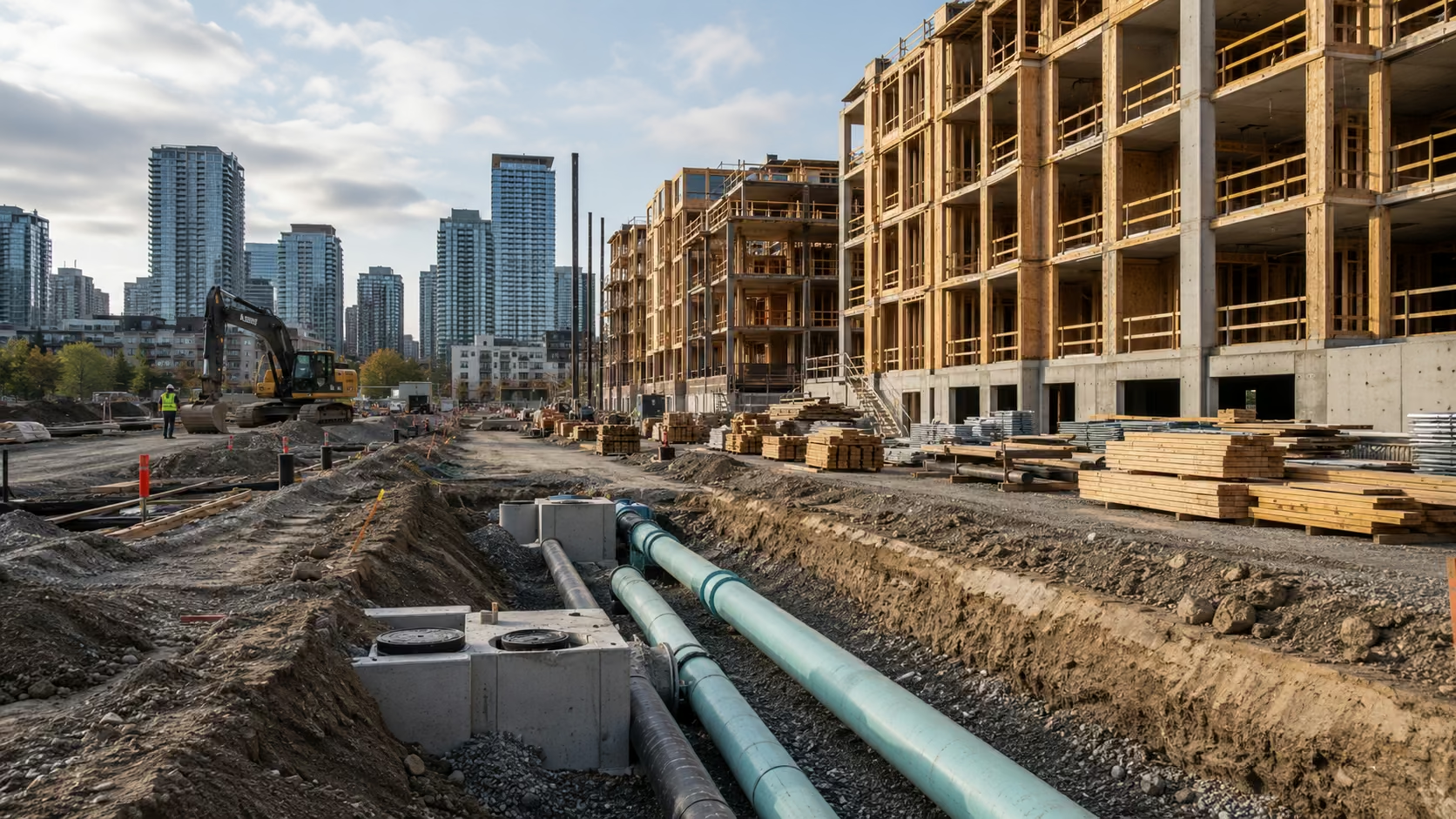
Toronto got its deal last week. And while the headline numbers are large, what actually matters is the model underneath them.
On June 23, the City of Toronto, the Province of Ontario, and the federal government announced that Toronto would receive up to $1.5 billion through the Development Charge Reduction Program, in exchange for cutting residential development charges by 40 to 60 percent across most unit types through 2029. The city estimates the program will support approximately 44,000 new homes and provide roughly $1.95 billion in relief to homebuilders. That's the local story. The more interesting story is what this signals for every other city in the country still running the old playbook.
The framework behind it was announced in March 2026: a combined $8.8 billion from Ottawa and Queen's Park, structured to fund housing-enabling infrastructure for municipalities that commit to cutting development charges by 30 to 50 percent or more for at least three years. Toronto's reduction exceeds that floor. It is also the first municipal announcement under the DCRP, which means every other Ontario municipality is now watching one city go first and collecting the evidence on whether it works.
The reason this matters beyond Toronto is structural. Only Ontario and British Columbia enable province-wide use of development charges. Those are also the two provinces with the most severe affordability problems and the most stalled construction pipelines. The federal government has now shown it will backstop the infrastructure revenue that municipalities lose when they cut fees. That is a different kind of policy signal than a tax rebate or a loan program. It removes the primary objection municipalities have used for decades: that they cannot reduce charges because they need the revenue to build roads and pipes. Ottawa is now saying, effectively, cut the fees and we will pay for the pipes.
Development charges in Toronto rose from roughly $14,000 per single-detached home in 2011 to over $137,000 by recent estimates, a nominal increase of close to 700 percent in about 15 years. Nationally, the Canadian Home Builders' Association says development charges have risen more than 700 percent over 25 years. Municipalities did not do this arbitrarily. They were filling a revenue gap that provincial transfers and property taxes left open. But every new home absorbed a larger and larger government fee before anyone picked up a hammer, and that cost never stayed with the developer. It went straight to buyers.
TRREB estimates development charges account for up to 20 percent of a home's purchase price in some Ontario markets. For a buyer already stretching to make a down payment, that 20 percent is not an abstraction. It is often the difference between qualifying and not.
What BC Is Getting, and What It Isn't
BC got its version of the deal four days after Toronto's announcement. Carney and Premier Eby announced a $3.2 billion federal-provincial package aimed at cutting development cost charges by up to 50 percent on multi-unit housing in priority communities. The mechanics are identical to Ontario's: federal money compensates municipalities for the infrastructure revenue they give up in exchange for lower upfront fees.
What BC's deal lacks, for now, is specificity. Toronto had a named dollar figure, a named reduction range, and a named timeline. BC's "priority communities" framework is still being defined, which means cities like Kelowna are waiting to find out if they qualify.
That wait is not free. In April 2026, Mayor Tom Dyas proposed a 25 percent reduction in Kelowna's development cost charges for two years, with staff estimating a 20 percent cut could produce between 200 and 350 additional homes. A councillor opposed it on the grounds that it would leave a $5 to $10 million shortfall in the city's infrastructure program. Both positions are defensible, and that is exactly why the federal backstop model exists: it resolves the conflict by covering the infrastructure gap the fee reduction creates. Staff noted explicitly that the cuts would align with potential federal infrastructure grants. The federal program has now confirmed what those grants look like. Kelowna's proposed 25 percent cut falls short of the 30 to 50 percent threshold the DCRP prioritizes, which is worth knowing before the city finalizes anything.
The Part Nobody Wants to Say Out Loud
Not everyone is confident savings reach buyers. A Toronto-based mortgage broker raised this directly when the Ontario-federal framework was announced, noting that builders could theoretically keep the fee reduction as margin rather than lower their asking prices. He is not wrong. In a market where new construction has been financially underwater for years, some builders will use savings to restore viability rather than discount. That is rational.
But the counterfactual is the thing. If charges stay high and projects do not pencil out, no homes get built at all. A builder who captures the savings but actually builds is still producing housing. A builder priced out of the market produces nothing. The more durable effect of these reductions will show up in project feasibility, not sticker prices. Stalled projects get unstalled. New projects that could not get financing get financed. Construction pipelines that have been running at 30-year lows start to refill.
The honest read on all of this is that Toronto's deal represents the first time federal money has been used at scale to break the structural loop that kept development charges rising for two decades. Municipalities could not reduce fees without losing revenue. Provinces would not make up the shortfall. Ottawa stayed out of it. That arrangement produced a 700 percent fee increase over 25 years and a housing construction crisis that shows up in almost every economic measure of what ails Canadian cities.
The loop is now broken in Ontario, and conditionally in BC. The federal Build Communities Strong Fund has allocations for every province and territory. The other provinces just have not moved yet. They are watching Toronto go first, and they are doing the math on whether the deal is worth taking. It is.
If you're buying new construction in the Okanagan and want to understand how development charge changes affect your situation, our team at Coldwell Banker Horizon Realty can walk you through what applies.
The content of this article is for informational purposes only and should not be considered as financial, legal, or professional advice. Coldwell Banker Horizon Realty makes no representations as to the accuracy, completeness, or suitability of the information provided. Readers are encouraged to consult with qualified professionals regarding their specific real estate, financial, and legal circumstances. The views expressed in this article may not necessarily reflect the views of Coldwell Banker Horizon Realty or its agents. Real estate market conditions and government policies may change, and readers should verify the latest updates with appropriate professionals.