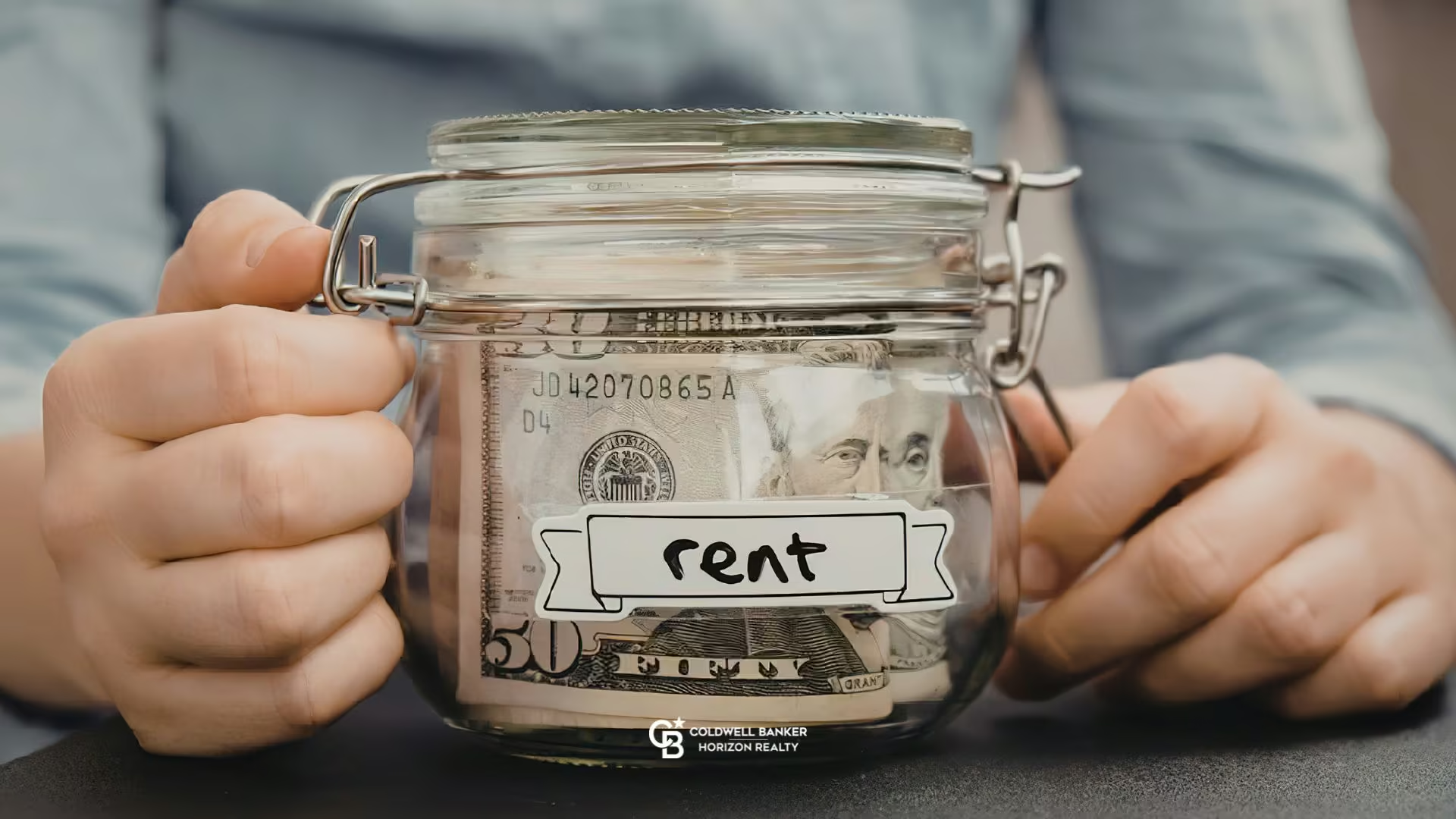
For a long time, telling someone to rent instead of buy in British Columbia was treated roughly the same as telling them to throw their money into Okanagan Lake. Ownership was the obviously correct answer. You were building equity. Renting was dead money. Everyone knew this.
That math is no longer obvious. And in BC specifically, it has quietly, measurably flipped.
This isn't a philosophical argument about flexibility versus stability, or a lifestyle piece about the freedom of not being responsible for a leaking roof. It's the actual monthly numbers at three points in time: 2021, 2023, and today. Run them yourself. The story is the same.
The Three Moments That Tell the Story
Take a two-bedroom condo in Kelowna as the baseline unit, comparable in size and quality whether you rent or own it. In 2021, the average condo price in the Kelowna market was around $440,000. The best available five-year fixed mortgage rate was approximately 1.69%. With a 20% down payment of $88,000, the monthly principal-and-interest payment on a 25-year amortization came to roughly $1,530. Add in property tax (approximately $210 per month) and strata fees (approximately $350 per month) and the total monthly carrying cost for a Kelowna condo owner landed around $2,090.
The equivalent two-bedroom rental at the time? Approximately $1,800 to $2,000 per month. Ownership cost slightly more on a monthly basis, but not dramatically so. The gap was narrow enough that equity accumulation and long-term price appreciation made owning the rational call for almost anyone planning to stay put.
By late 2023, that calculation had collapsed. Condo prices in Kelowna had climbed to around $510,000, while the Bank of Canada had hiked rates to combat inflation, pushing five-year fixed mortgage rates toward 5.5%. A 20% down payment of $102,000 left a mortgage of $408,000. Monthly principal and interest at 5.5% over 25 years: approximately $2,500. Add property tax ($250/month) and strata ($380/month) and the monthly ownership cost was around $3,130. Meanwhile, BC rents had peaked in September 2023. A two-bedroom in Kelowna was running roughly $2,300 to $2,500 per month at the height of that market. Owning the equivalent unit cost somewhere between $600 and $800 more per month than renting it. Before maintenance, before insurance, before the opportunity cost of the down payment sitting in the property instead of a brokerage account.
That 2023 gap is when the rent-vs-buy calculation in BC broke. It became hard to justify ownership on a cash-flow basis alone. The argument shifted entirely to long-term appreciation, and people made that bet at the worst possible time.
Where We Are in 2026
In February 2026, the BC government confirmed that purpose-built apartment and condo asking rents across the province are down 11.8% from their September 2023 peak. In Kelowna specifically, two-bedroom asking rents have fallen roughly 11% year-over-year. The average two-bedroom is now available in the $2,000 to $2,200 range depending on building and location, a meaningful drop from the frenzy of 2023.
Mortgage rates have improved significantly from their 2023 peak. As of March 2026, the best available five-year fixed insured rate sits around 3.94%, with some brokers reaching 3.84% for conventional mortgages. But here is the problem: Kelowna condo prices haven't moved much from that 2023 peak. The average remains around $510,000. Lower rates have partially reduced the monthly payment, but haven't restored the affordability that existed in 2021.
Run the current math. A $510,000 condo, 20% down ($102,000), mortgage of $408,000 at 3.94% over 25 years: monthly principal and interest of approximately $2,130. Property tax around $250 per month. Strata fees around $400 per month for a typical two-bedroom. Total monthly ownership cost: approximately $2,780.
The equivalent rental unit in Kelowna today: approximately $2,000 to $2,200 per month.
The monthly gap between owning and renting a comparable two-bedroom in Kelowna is currently somewhere between $580 and $780. Before maintenance costs, before the opportunity cost of the $102,000 down payment, and before BC's property transfer tax, which adds another $8,000 to $10,000 at closing that renters never have to think about.
Renting is genuinely cheaper, on a pure monthly-cost basis, by a significant margin. That is not a fringe position. It is the math.
Nationally, average asking rents in Canada fell to $2,030 in February 2026, their lowest level in 33 months, and rents have declined for 17 consecutive months. British Columbia led all provinces in rent declines, with asking rents down 4.9% year-over-year and apartment rents in Vancouver posting a 7.2% annual drop, the steepest fall among Canada's six largest markets. The rent-to-income ratio nationally has fallen to 29.5%, its lowest level in six years.
The ownership side of the ledger, meanwhile, has not recovered proportionally. CREA's February 2026 data showed the national average home price at $663,828, essentially unchanged year-over-year. The MLS Home Price Index fell 4.8% year-over-year nationally, but BC prices have been stickier, particularly in markets like Kelowna where lifestyle demand and limited land keep a floor under values.
When Does the Math Flip Back?
This is the question that actually matters, because buying is still the right long-term call for many people. The rent-vs-buy gap closes when one of three things happens: rents rise again, prices fall meaningfully, or mortgage rates drop far enough to close the monthly cost gap. The most likely scenario in BC is a combination of modest price increases as pent-up buyer demand returns. CREA forecasts BC sales volume rising over 8% in 2026. Rents, meanwhile, will stabilize as new supply slows. The rental construction that drove the decline was financed and started in 2022 and 2023. Starts are softening. The pipeline has a natural end.
But for the next 12 to 18 months, the math still favours renting, particularly for anyone without a substantial down payment already in place. The opportunity cost of deploying $100,000 into a down payment, when that capital could sit in a high-interest savings account at roughly 4% or in a diversified portfolio, is real and should be part of every calculation buyers run.
None of this means buying is wrong. It means buying requires a longer time horizon and a clearer-eyed view of what you're actually paying for. If you plan to stay in a Kelowna property for seven to ten years, the long-term case for ownership still holds. The city's underlying demand drivers, including lifestyle, climate, UBC Okanagan, and retiree migration, haven't disappeared. But the argument that buying is obviously better than renting, that it was ever purely rational and not partly cultural, has taken a serious hit from three years of data.
The math flipped. Most people haven't updated their assumptions to match.
The content of this article is for informational purposes only and should not be considered as financial, legal, or professional advice. Coldwell Banker Horizon Realty makes no representations as to the accuracy, completeness, or suitability of the information provided. Readers are encouraged to consult with qualified professionals regarding their specific real estate, financial, and legal circumstances. The views expressed in this article may not necessarily reflect the views of Coldwell Banker Horizon Realty or its agents. Real estate market conditions and government policies may change, and readers should verify the latest updates with appropriate professionals.