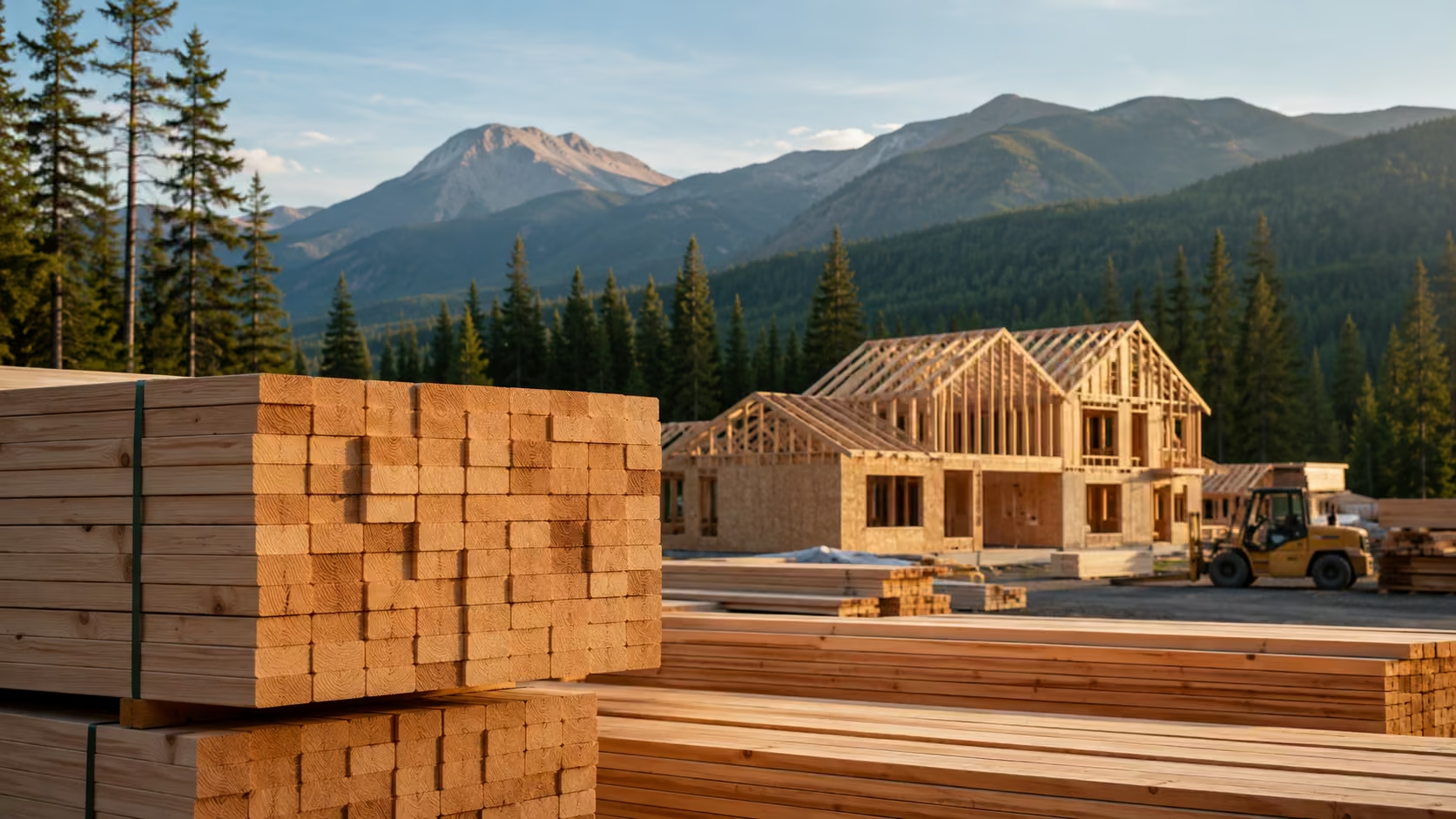
In April 2026, the US Department of Commerce released preliminary results from its seventh annual review of Canadian softwood lumber duties. The preliminary antidumping rate dropped from 20.6% to 10.7%. Combined with a slight dip in countervailing duties, the all-in rate on most Canadian producers fell from around 35.9% to around 25.9%, before the standing 10% Section 232 tariff is added on top.
In other words, the combined rate may be heading from roughly 46% toward roughly 36%. Still a wall. But a slightly shorter one.
NAHB, the US homebuilders' lobby that has been loudest in calling for a negotiated solution, responded immediately by urging the Trump administration to suspend tariffs on Canadian lumber and move immediately into negotiations with Canada on a new softwood lumber agreement that would eliminate tariffs altogether. That call has been sitting on the administration's desk, in various forms, for the better part of two years.
This is the article about whether anyone will pick it up. And why the answer, despite everything, is not obvious.
Forty years of the same argument
The Canada-US softwood lumber dispute is the longest-running and most litigated bilateral trade conflict between two countries that are otherwise deeply integrated. It started in 1982. The core claim has never changed.
In the United States, most commercial timberland is privately owned. Companies bid competitively for the right to harvest timber, and the price is set by the market. In Canada, roughly 94% of forests are publicly owned, and provincial governments set the stumpage fees that companies pay to log on Crown land. The US lumber industry has argued since 1982 that those government-set fees are set too low, effectively subsidizing Canadian producers and allowing them to undercut American mills on price. Canada has argued, consistently and successfully, that its stumpage system is not a subsidy.
Canada has won at every international tribunal that has examined the question in any depth. WTO panels found in Canada's favour. NAFTA and CUSMA dispute resolution panels sided with Canada. The US has not disputed those rulings so much as ignored them, appealed them, and then initiated new proceedings once the old ones concluded.
The dispute has been temporarily paused twice by managed trade agreements. The 1996 Softwood Lumber Agreement ran from 1996 to 2001, imposing a quota system that limited Canadian exports to 14.7 billion board feet annually. The 2006 Softwood Lumber Agreement, which came into force in October 2006 for an initial seven-year term with a two-year extension, required Canada to impose export charges or quotas whenever US lumber prices fell below a specified level. In exchange, the US returned more than $5 billion in duty deposits to Canadian companies.
Both agreements held while they were in force. Both collapsed within two years of expiry. The pattern is so consistent it almost looks like policy design rather than accident: negotiate a pause, collect some goodwill, watch the dispute reignite, repeat.
We are now in what trade observers call Lumber V, the fifth major iteration, which began after the 2006 SLA expired in October 2015. It is, by some measures, the worst one yet.
The fight happening inside the United States
What makes the current moment genuinely different from prior rounds is the intensity of the split within the American industry itself.
On one side: the US Lumber Coalition, which represents domestic sawmill operators. Their position has not moved. They argue that US annual softwood lumber capacity increased by approximately 8 billion board feet from 2015 to July 2025, and that another decade of growth at that rate would enable the US industry to achieve capacity sufficient to meet consumption needs in a typical year. In their framing, Canada is not a necessary supplier but a problem to be solved: a producer of subsidized excess capacity that dumps cheap lumber into the US market and prevents American mills from reaching their potential. They explicitly called Canada's push for a new SLA "a request for a massive US taxpayer-funded bailout to support Canadian jobs at the direct expense of American workers."
On the other side: NAHB, which represents the people who actually build homes. Their position is equally direct: more than 60% of builders surveyed by NAHB have reported seeing higher costs due to tariffs, and builders estimate a typical cost effect from recent tariff actions at $10,900 per home. US mills, they argue, are operating at just 64% of their potential capacity and cannot ramp up fast enough to replace Canadian supply. US sawmills need years to expand production to meet domestic needs, and in the interim, imports of softwood lumber remain vital to build and repair American homes.
Both of these things can be simultaneously true. The US lumber industry is genuinely growing and genuinely cannot yet replace Canadian supply. NAHB's direct lobbying in Congress and face-to-face meetings with senior trade officials give them access. The Lumber Coalition has the ideological alignment with the current administration's economic nationalism. The result is a policy fight where both sides are winning arguments in different rooms, and no one in the White House has decided which room matters more.
The USMCA window and what it actually contains
The most concrete political opening for a deal in a generation is the USMCA joint review, which is formally scheduled for July 1, 2026. Under the agreement's terms, all three parties must review USMCA every six years and decide whether to extend it for another 16 years or move into annual reviews. Canada's chief trade negotiator has acknowledged that both nations have been discussing softwood lumber quotas in the lead-up to that review. Canadian minister LeBlanc stated explicitly that Ottawa had told US counterparts it would need movement on softwood lumber in BC in exchange for provincial policy changes the US wants.
But the USMCA review and a softwood lumber agreement are not the same thing, and conflating them overstates the opportunity. The Trump administration has demanded preconditions from Canada before entering serious negotiations: movement on dairy access, provincial alcohol bans, and other irritants. Canada has resisted the precondition framework, noting it received nothing in return for previous concessions including the scrapping of the digital services tax. As of late April 2026, formal US-Canada USMCA negotiations had not yet begun.
There is another structural problem: the Section 232 tariff. The 10% lumber tariff imposed in October 2025 was applied under the national security authority of the Trade Expansion Act of 1962, a different legal instrument from the antidumping and countervailing duties that a new SLA would address. A negotiated softwood lumber agreement could in theory reduce or eliminate the AD/CVD duties, but the Section 232 tariff would require separate presidential action to remove. There is currently no exemption from the Section 232 tariff for goods that comply with USMCA. In other words, even a successful new SLA might leave a floor of 10% duties in place unless the White House explicitly extended any deal to cover the Section 232 layer.
That detail alone explains why Canada views a new SLA as a more complicated ask than it appears.
What a deal would actually do to lumber prices
If the political obstacles were somehow cleared and a new SLA were signed, it would not return the market to pre-tariff conditions. Every managed trade agreement in the history of this dispute has worked by restricting Canadian supply to prop up US prices, not by letting the market clear freely.
The 1996 SLA's quota system pushed US lumber prices roughly 16% higher on average for the agreement's first four years, with large gains to US producers and even larger losses to US consumers. The 2006 SLA used a price-triggered export charge mechanism: when US prices fell below a specified threshold, Canada was required to impose export taxes, effectively putting a floor under the market. The point of a managed trade agreement, from the US Lumber Coalition's perspective, is always to support domestic prices, not lower them.
A new SLA negotiated today would almost certainly follow the same structure. Canada would accept export restrictions or price floors in exchange for AD/CVD relief. The result: lumber prices in both countries stabilize or rise above what they would be in a free market. Canadian builders lose the current window of relatively lower domestic prices. Construction costs go up, from a different direction than if no deal is reached.
For Canadian homebuyers and developers, the irony is pointed. The policy solution to the lumber crisis produces the same outcome as the continued crisis: higher building material costs. The mechanism differs. The direction does not.
The irreversibility no deal can fix
There is a harder problem beneath all of this, and it does not appear in any SLA negotiating brief.
Since 2022, 22 mills have permanently closed and more than 50 have reduced operations across Canada. Permanent is the operative word. Opening a sawmill is not the reverse of closing one. It requires capital investment that cash-negative companies cannot finance, timber tenure access that takes years to secure and activate, a trained workforce that has largely dispersed into other industries or other provinces, and ramp-up time measured in years, not months.
A deal signed in the second half of 2026 cannot restore the mill capacity destroyed in 2023, 2024, and 2025. That capacity is gone. The towns that lost those mills, 100 Mile House, Vanderhoof, communities across the BC Interior, do not get their economic anchor back on the strength of a diplomatic agreement. What a deal can do is slow further closures of mills still operating, preserve what remains of Canadian export capacity, and give the companies that survived the crisis a path back to their primary market.
That matters. But it is a ceiling on what a deal can achieve, and it is lower than most of the political discourse acknowledges.
Where this leaves Canada
Canada right now is building its housing and forestry policy around the assumption that the US door stays roughly closed through at least 2027. The Build Canada Homes program, the Buy Canadian policy, the $2.35 billion in forest sector supports, the Forest Sector Transformation Task Force: all of these are predicated on domestic absorption becoming the new primary demand channel for Canadian lumber, with Asia as a secondary market to develop over time.
If a deal is reached, this domestic pivot loses some of its urgency. Government procurement mandates requiring Canadian lumber feel less strategic when Canadian lumber is flowing to American homebuilders again. Investment in mass timber manufacturing becomes less immediately necessary when commodity export markets reopen.
But if no deal is reached, the domestic pivot becomes less a choice than a survival mechanism. The question shifts from "should Canada reorient its forest industry toward domestic use" to "can it reorient fast enough before too many more mills close permanently." That question has an uncomfortable answer if you are tracking the rate at which BC's fibre supply is declining.
BC's allowable annual cut has fallen by one-third over 20 years. That problem does not wait for a USMCA review.
The next article in this series looks at the scenario where Canada stops competing in commodity lumber altogether, and whether the global mass timber market offers a path out that does not depend on what anyone in Washington decides.
The content of this article is for informational purposes only and should not be considered as financial, legal, or professional advice. Coldwell Banker Horizon Realty makes no representations as to the accuracy, completeness, or suitability of the information provided. Readers are encouraged to consult with qualified professionals regarding their specific real estate, financial, and legal circumstances. The views expressed in this article may not necessarily reflect the views of Coldwell Banker Horizon Realty or its agents. Real estate market conditions and government policies may change, and readers should verify the latest updates with appropriate professionals.