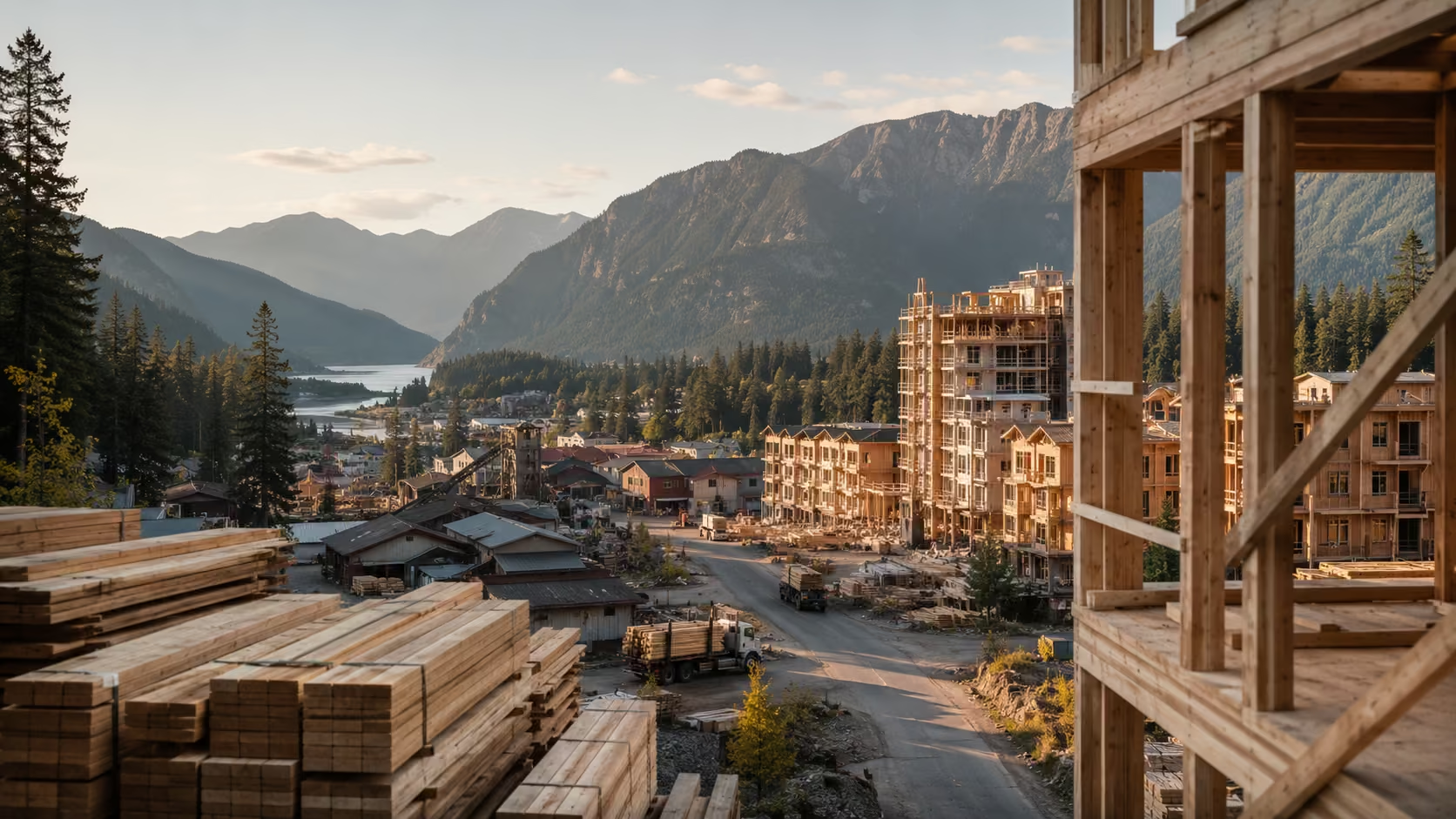
There is a town in BC's South Cariboo called 100 Mile House. For decades it had one major employer: a West Fraser sawmill. In November 2025, West Fraser announced it was shutting the mill permanently. 165 direct jobs gone. The mayor estimated at least 500 more indirect jobs would follow. She said she worried the closure would push people out of a town that had always seen itself as a lumber community.
One month later, in Ottawa, the federal government was announcing a new Crown corporation called Build Canada Homes, tasked with building hundreds of thousands of affordable homes across the country using, among other materials, Canadian lumber.
Both things are true. At the same time. In the same country.
Canada is the world's largest softwood lumber exporter. It has one of the worst housing shortages in the G7. And the industry that produces its primary building material is in structural collapse. These facts are not in tension because someone made a policy mistake. They are in tension because four separate crises, each with its own decades-long history, have arrived at the same point simultaneously, and almost no one is talking about all of them at once.
This article will not resolve the paradox. That is what the next six are for. This one is just about helping you see the whole shape of it.
The wall went up in 1982
The Canada-US softwood lumber dispute is older than most of the houses it is supposed to build. The American side has argued since 1982 that Canada's stumpage fees, the prices provincial governments charge companies to harvest timber on Crown land, amount to an unfair subsidy. In the US, most timber is privately owned and priced by the market. In Canada, roughly 94% of forests are publicly owned. The US position is that public ownership plus government-set fees equals a subsidy. Canada has won at every international tribunal that has examined the question. The WTO sided with Canada. CUSMA dispute panels sided with Canada. None of it mattered. The duties kept coming.
What changed in 2025 is the scale. Combined antidumping and countervailing duties reached 35.16% on most Canadian producers, up sharply from the previous 14.4%. Then in October 2025, the Trump administration added a 10% tariff under Section 232 of the Trade Expansion Act, the national security provision that lets a president impose trade restrictions without congressional approval. That tariff stacks on top of the existing duties. The all-in rate for most Canadian producers is now 45.16%.
In November 2025 alone, BC's exports of solid wood products to the US fell 35.7% year-over-year. That is not a market adjustment. That is a door slamming.
The industry was already breaking before the door slammed
This is the part most coverage gets wrong. The tariff crisis is real and urgent. But it landed on an industry that was already in serious trouble, for reasons that have nothing to do with American trade policy.
BC's allowable annual cut has fallen by one-third over 20 years due to timberland setasides, Indigenous rights settlements, insect infestations, and wildfire losses. The mountain pine beetle epidemic of the early 2000s killed a massive fraction of the Interior's lodgepole pine. Governments responded by temporarily increasing harvest allowances to enable salvage logging of the dead timber, which kept mills running through a period that looked like health but was actually extraction of a one-time windfall. When the salvage ran out around 2019, the reckoning started. Then wildfires took over. BC alone lost 1.4 million hectares of forest to fire in 2023.
The result: in 2023, actual BC timber harvest volumes were 40% below the province's own official allowable annual cut. Not below historical peaks. Below what the government's independent chief forester had deemed sustainable. The economically viable timber was not there to harvest at the approved levels.
Canadian softwood lumber production fell roughly 26% between 2017 and 2024. In BC, production now sits at around half of 2017 levels. Since 2022, 22 mills have permanently closed and more than 50 have reduced operations, directly affecting over 5,600 workers. The tariffs did not cause this trajectory. They sharpened it into a crisis.
And this matters enormously for what comes next, because it means the obvious fix is not actually available. If a Canada-US trade deal were signed tomorrow, if the duties disappeared overnight, BC's mills could not simply return to 2017 production levels. The trees are fewer, smaller, and harder to reach than they were. The structural floor has dropped, regardless of what happens in Washington.
On the other side of this, 3.5 million missing homes
While all of this was unfolding in the forests, Canada's housing shortage was compounding. CMHC has estimated Canada needs roughly 3.5 million additional homes by 2030 to restore affordability. National housing starts reached 259,000 in 2025, up 6% year-over-year. At that pace, Canada is building at less than half the rate it needs to close the gap, before accounting for population growth continuing to widen it.
The homes Canada needs to build require lumber. The industry that produces that lumber is in collapse. The government's response to both problems, which it unveiled in the same news cycle as the mill closures, is to connect them: use Canadian lumber to build Canadian homes, redirect the supply chain inward, and transform what was an export-dependent commodity industry into the backbone of a domestic construction boom.
Ottawa has committed $2.35 billion in measures to protect and transform the forest sector, including $1.7 billion in loans and loan guarantees. Build Canada Homes is now a Crown corporation with a mandate to build affordable housing using Canadian materials, prioritizing mass timber and factory-built construction. The Buy Canadian policy requires federal procurement to put domestic wood products first.
It is an elegant policy response to an ugly situation. Whether the math actually works is a different question entirely.
What this series is about
The Canadian lumber paradox is not one story. It is at least five, layered on top of each other, each with its own logic and its own timeline and its own set of winners and losers that do not appear in the press releases.
There is the story of who actually holds the losses when mills close, and it is not who you expect. There is the story of why cheap lumber is not making Canadian homes cheaper, which has everything to do with currency and construction cost structure. There is the question of whether a new Canada-US Softwood Lumber Agreement could change the entire picture, and why the deal that seems obvious has not happened in 40 years. There is the global mass timber market, which is growing at nearly 15% annually and which Canada is positioned to lead if it can get its manufacturing capacity built before the fibre supply problem forecloses even that option. And there is the question of who will own BC's forests in ten years, which is being answered right now in a series of tenure transfers that are moving faster than anyone anticipated.
Article 2 publishes tomorrow. It starts with the mill closures and the question everyone is avoiding: when an industry collapses, the losses go somewhere. Where did they go?
The content of this article is for informational purposes only and should not be considered as financial, legal, or professional advice. Coldwell Banker Horizon Realty makes no representations as to the accuracy, completeness, or suitability of the information provided. Readers are encouraged to consult with qualified professionals regarding their specific real estate, financial, and legal circumstances. The views expressed in this article may not necessarily reflect the views of Coldwell Banker Horizon Realty or its agents. Real estate market conditions and government policies may change, and readers should verify the latest updates with appropriate professionals.