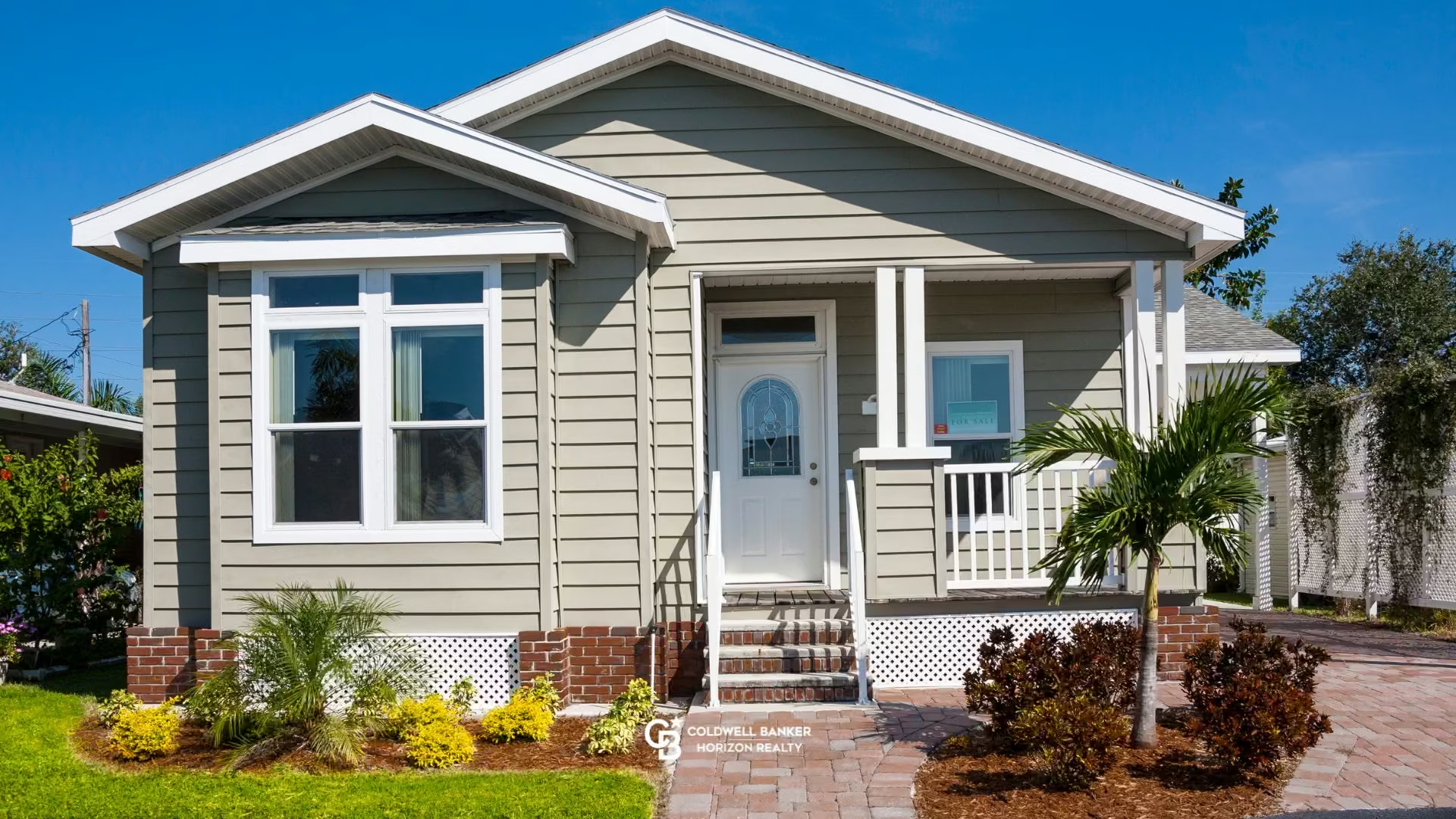
In 1984, the average Canadian home cost about $76,000. The catch was a mortgage rate that had recently touched 21.75%, the highest in Canadian history. Monthly carrying costs were brutal, which is why buyers were cautious and prices stayed grounded.
In February 2022, that same national average hit a record $816,720, with rates near 2%. By spring 2026 it sits around $659,000, still roughly nine times what it was four decades ago.
Most people frame that gap as a supply problem, or a greed problem, or a government failure. All of those things are real and contributed. But there is a less discussed structural driver sitting underneath all of them, one that operated quietly across four decades: mortgage rates fell almost continuously from 1981 to 2021, and every time they fell, buyers could afford to bid more for the same house. Sellers figured that out. Prices rose to absorb the new borrowing capacity. Then rates fell again. Prices rose again. Repeat for forty years.
What lower rates actually do to a housing market
The mechanism is simple enough to explain in a single sentence. When the cost of borrowing falls, the monthly payment on a given loan shrinks. That means a buyer with the same income can now service a larger mortgage for the same monthly outlay. When millions of buyers can suddenly borrow more, bidding on a fixed pool of homes, sellers capture that new capacity in the form of higher prices.
This isn't conspiracy. It's basic supply and demand with one unusual input: cheap credit.
A rough illustration across the decades makes the pattern visible. The 1980s opened with 5-year fixed posted rates averaging around 13.60% for the decade, having peaked at 21.75% in 1981. By 1987 they had fallen to around 10%. The 1990s average landed near 9.10%. The 2000s averaged roughly 6.80%. The 2010s brought the first sustained period below 5%, and the pandemic pushed variable rates below 2% for the first time in Canadian history.
At each step down, the borrowing power of a median-income household expanded. The national average home price was $163,524 in 2000 and had risen to $339,042 by 2010, a doubling that tracked almost perfectly with the continued decline in borrowing costs over that same decade. By 2020, national average prices had climbed further to around $531,000, with rates at historic lows. Then the pandemic cut rates to the floor, credit surged, and prices went completely vertical before the 2022 correction.
Rates were not the only force. Supply constraints, restrictive zoning, demographic demand waves, investor activity, and tax treatment of principal residences all mattered. But the inverse relationship between mortgage rates and real home prices across Canada from 1975 onward is well-documented, and researchers who have tracked the data closely estimate that the secular decline in rates accounts for a substantial share of real price appreciation over the period. The Canadian MoneySaver analysis noted that when variable rates sat near 10% between 1975 and 1990, inflation-adjusted home prices were largely flat. As rates fell below that threshold and kept going, real prices began their long climb.
There is also a comparison that puts the rate sensitivity in sharper relief. In 1981, the national average home cost roughly three to four times median household income. By the 2022 peak, that ratio had reached a level many analysts estimated at eight or nine times nationally, and considerably higher in Vancouver and Toronto. The price-to-income ratio did not expand because incomes collapsed. It expanded because falling rates meant buyers kept accepting higher and higher prices, and sellers obliged.
The tailwind has stopped
Here is where the story turns consequential for anyone thinking about Canadian real estate over the next decade.
The Bank of Canada's overnight rate currently sits at 2.25%. That is not a high rate by historical standards, but there is no 20-percentage-point decline available from here. The extraordinary tailwind that mechanically supported price appreciation for four decades has largely been spent. Rates can still move lower during a downturn, and any future cuts will still help buyers at the margin. But the structural engine, where each rate cycle delivered a fresh batch of borrowing capacity that bid prices higher, cannot repeat at the same scale.
Canadian MoneySaver's analysis of the long-run data put it plainly: given that rates are now starting from around 5% at their recent peak, it may be challenging for home prices to appreciate much beyond the rate of inflation going forward. That does not mean prices are going to crash. It means the automatic wind at buyers' backs is gone, and price appreciation from here will need to come from real income growth, population demand, or genuine supply constraints rather than from the quiet mathematics of declining borrowing costs.
This matters for how you think about real estate as an investment. A buyer who purchased in 1990 and held through 2020 benefited not just from their own financial decisions, but from a 30-year structural tailwind that kept lifting values as rates fell. That tailwind was real. It was also a one-time gift tied to a specific macro environment that no longer exists. The next buyer entering today gets a market where prices remain well above historical affordability norms relative to income, where rates have already normalized from their pandemic lows, and where future gains depend on factors that are harder to predict and less mechanical than "rates kept falling."
None of that makes Canadian real estate a bad bet. In most BC markets, particularly in supply-constrained cities like Kelowna where land and zoning create a genuine ceiling on inventory, the long-term case for ownership still rests on real fundamentals. But it does mean the playbook that worked for the last forty years, buy anything, hold it, let falling rates do the work, is no longer available. Future buyers will need to actually think about the underlying asset. Which, if you stop to consider it, is probably how it should have been all along.
The content of this article is for informational purposes only and should not be considered as financial, legal, or professional advice. Coldwell Banker Horizon Realty makes no representations as to the accuracy, completeness, or suitability of the information provided. Readers are encouraged to consult with qualified professionals regarding their specific real estate, financial, and legal circumstances. The views expressed in this article may not necessarily reflect the views of Coldwell Banker Horizon Realty or its agents. Real estate market conditions and government policies may change, and readers should verify the latest updates with appropriate professionals.