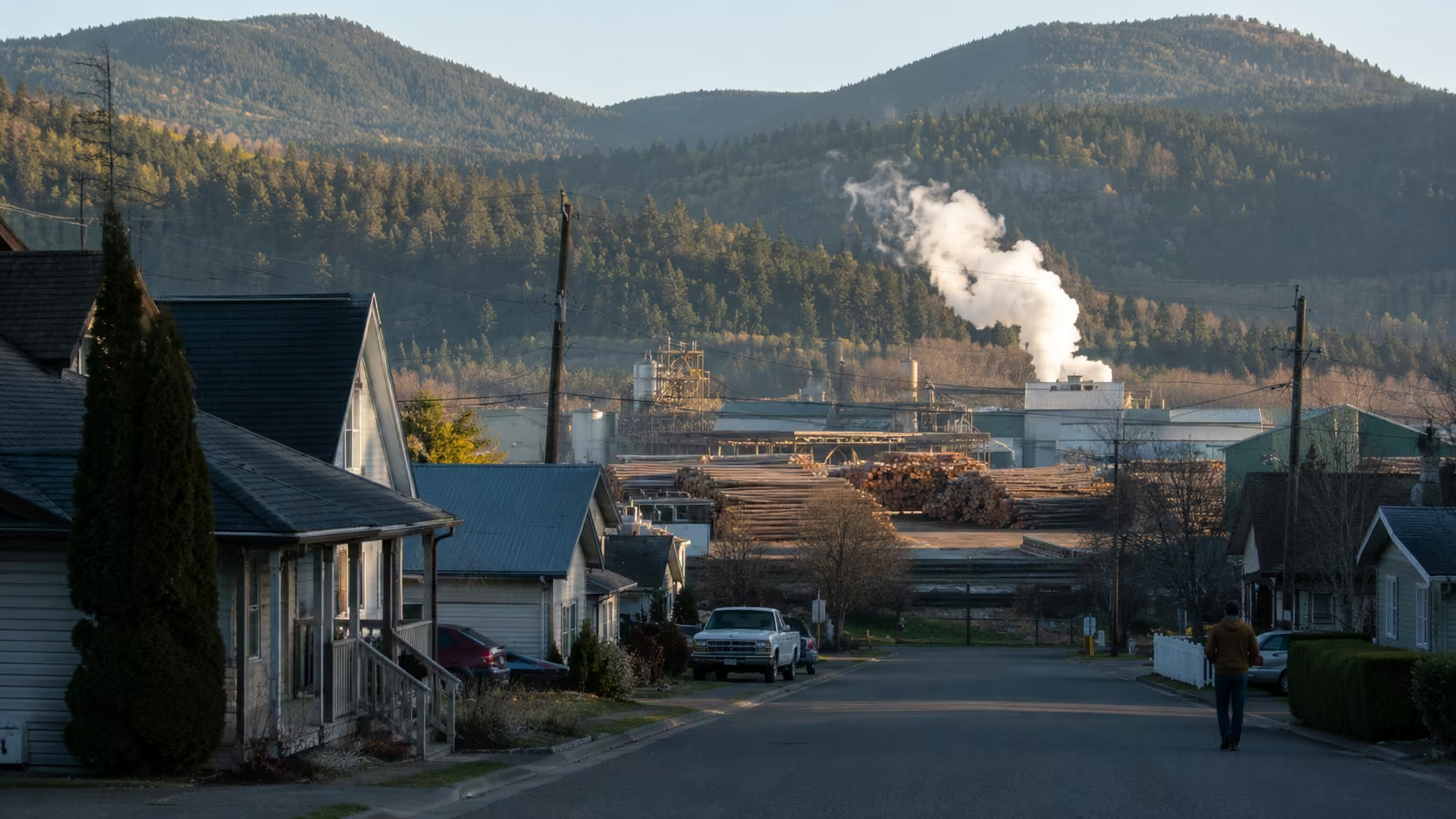
When Canfor announced in September 2024 that it was shutting its Plateau sawmill in Vanderhoof and its Fort St. John operation, the company's statement listed four reasons: "accessing economically viable timber, ongoing financial losses, weak lumber markets, and increased US tariffs." All four are real. But the order matters.
Timber access and financial losses were already eroding these operations before the latest tariff escalation. The tariffs were the final blow, not the original wound. And while Canfor was announcing those 500 job losses in northern BC, it was simultaneously managing a network of 11 sawmills in Georgia, North Carolina, Mississippi, and neighbouring states, all of which are entirely exempt from the very tariffs that just killed the Canadian operations.
That exemption is the detail that changes the entire story of what is happening to the Canadian lumber industry right now.
The scoreboard that nobody is showing you
Canada's three largest forest products companies, West Fraser, Canfor, and Interfor, are widely described as victims of American trade aggression. That framing is accurate as far as it goes. But it omits something significant: these three companies now collectively operate more sawmills in the US than in Canada.
West Fraser runs 16 sawmills across the US South, compared to 13 in Canada. Canfor operates 11 mills in Georgia, North Carolina, Mississippi, and neighbouring states. Interfor manages 13 US sawmills, which account for the majority of its lumber output. Companies with Canadian head offices control approximately 35% of sawmill capacity in the US South specifically, and 22% of total US lumber capacity.
This did not happen in 2024. It has been underway for two decades. The US South, with its fast-growing private pine plantations, lower regulatory costs, and proximity to the large US housing market, has been drawing Canadian forestry capital steadily since the early 2000s. The tariff regime since 2017 accelerated that capital flow. As combined duties on Canadian-origin lumber climbed beyond 35%, the economic logic became straightforward: build or buy mills in the US, produce from there, and sell into the same market without paying any duties.
West Fraser made this explicit in its 2025 annual results. While announcing the permanent closure of its 100 Mile House BC mill and curtailments at other Canadian operations, the company also highlighted completing its new lumber mill in Henderson, Texas, and ramping up its large-scale OSB facility in Allendale, South Carolina, as major milestones for the year. The company ended 2025 with more than $1.2 billion in available liquidity, paid $101 million in dividends, and repurchased $124 million of its own shares. This is not what a dying company looks like. It is what a company pruning its highest-cost assets while investing in its most competitive ones looks like.
The paradox the tariffs created
Here is the part that should give everyone pause.
The US tariffs on Canadian lumber were designed to protect American producers by making Canadian imports more expensive. They did protect American producers, by raising the price floor and reducing Canadian competition in US markets. But the companies that benefited most from reduced Canadian competition in US markets included West Fraser, Canfor, and Interfor, operating their American subsidiaries. Production from US sawmills, including those owned by Canadian-based companies, is entirely exempt from the lumber duties.
So the tariffs simultaneously devastated the Canadian operations of these companies and improved the competitive position of their American operations. The same corporate parent loses money in BC and gains market share in Georgia. The tariff regime did not destroy these companies. It restructured them, at the expense of BC workers and communities.
Interfor saw 64% of its total lumber production come from the US as of 2023, before the tariff escalation intensified. That number has only moved in one direction since. After closing facilities in South Carolina and selling its Quebec operations, Interfor recalibrated its operating mix to approximately 35% US South, 35% Sweden, and 30% Western Canada. Geographic diversification explicitly reducing reliance on tariff-exposed Canadian production.
None of this means these companies did anything wrong. Capital flows toward lower costs and fewer restrictions. The US South offers faster-growing trees, private land ownership, lower stumpage costs, and proximity to the market these companies sell into. BC offered old-growth primary forests for a century, and those forests are largely gone. The companies are making rational decisions. The workers in Vanderhoof and 100 Mile House are paying the cost of those decisions, and the distinction matters.
What the closures actually look like on the ground
The mill closure wave is not abstract. It is concentrated in places that have nothing to fall back on.
Canfor's Plateau mill in Vanderhoof and its Fort St. John operation: approximately 500 workers directly, in communities where forestry was not one employer among many but the economic reason the town exists at its current size. The United Steelworkers local described their members as "devastated." The BC Forests Minister called it "gut-wrenching."
West Fraser's 100 Mile House mill: 165 direct jobs in a community of around 2,000 people. The mayor estimated at least 500 indirect jobs would also be impacted and said she worried the closure would push people out of the town. She was not being dramatic. When the largest employer in a small town closes, the effect is not linear. The grocery store loses customers. The hockey arena loses families. The school rolls drop. The real estate market softens as people leave. What looks like 165 jobs on a spreadsheet is a community asking whether it has a future.
Prince George, Bear Lake, Houston, Vanderhoof, Fort St. John, Williams Lake, 100 Mile House: these are the communities that have absorbed closures since spring 2024, in a series that has collectively removed hundreds of millions of board feet of annual capacity across BC's Interior.
The distressed asset play
At the same time the multinationals are exiting BC, a different kind of player is moving in.
In May 2025, Weyerhaeuser announced the sale of its Princeton BC mill and all of its associated timber tenures to Gorman Group, a family-owned company based in West Kelowna. The transaction closed at approximately $120 million. Gorman committed to value-added manufacturing, co-operation with First Nations, and long-term investment in the Princeton area and its surrounding communities.
This is what the restructuring looks like from the other end. A Seattle-based global timberland REIT exits BC at a moment of maximum industry stress. A BC Interior family company buys in, betting that the domestic pivot, Build Canada Homes, Buy Canadian procurement, mass timber manufacturing, creates a viable market for BC-produced lumber over the next decade.
Gorman is not alone. Regional domestic operators are acquiring assets that multinationals are walking away from, at prices that reflect the industry's current distress. Whether that bet pays off depends on whether the government's domestic demand program can actually scale fast enough to justify the capital, a question Articles 3 and 4 in this series examine directly.
What the government offered the workers
When an industry restructures at this speed and scale, government support becomes the primary buffer for the people who absorb the direct impact.
Ottawa committed $2.35 billion to protect and transform the forest sector. The breakdown matters. $1.7 billion is loans and loan guarantees to producers, structured as repayable debt. $500 million goes toward market diversification and transformation programs. $50 million over three years is allocated to reskill and support more than 6,000 affected forest workers.
Run that last number. $50 million divided by 6,000 workers over three years is roughly $8,300 per worker. For retraining in regions where the next viable industry is hours away by highway, where the trades and skills of sawmill work do not transfer directly into software development or health care, where the average age of forestry workers skews older and relocation is not a neutral option when your family, your house, and your community are rooted in a town of 2,000 people.
The $1.7 billion for the companies is a loan. The $50 million for the workers is a program. Both numbers reflect where policy attention actually sits.
The real estate thread
This series is about lumber and housing, and the connection here is direct, though it runs differently than you might expect.
When BC Interior mill towns lose their primary employer, the local housing market does not boom. It deflates. Workers leave for Fort McMurray or Kelowna or wherever the next opportunity is. Listings accumulate without buyers. Prices compress. For homeowners in those communities, the mill closure is not just an employment story. It is a wealth story.
Kelowna sits downstream of this. It is the regional hub, the service centre, the medical destination, the school choice city for much of BC's Interior. When the Interior hollows out economically, some of that shows up as demand softening in Kelowna's secondary and satellite markets. And when mill workers relocate, some of them land in Kelowna, joining the pressure on a rental market that was already tight.
The lumber industry's structural collapse is not only a problem for lumber communities. It reshapes the demand geography of an entire region.
Tomorrow's article takes the other side of this: Canadian builders who were told cheap lumber was coming their way, and why the math never quite worked out the way the headlines promised.
The content of this article is for informational purposes only and should not be considered as financial, legal, or professional advice. Coldwell Banker Horizon Realty makes no representations as to the accuracy, completeness, or suitability of the information provided. Readers are encouraged to consult with qualified professionals regarding their specific real estate, financial, and legal circumstances. The views expressed in this article may not necessarily reflect the views of Coldwell Banker Horizon Realty or its agents. Real estate market conditions and government policies may change, and readers should verify the latest updates with appropriate professionals.