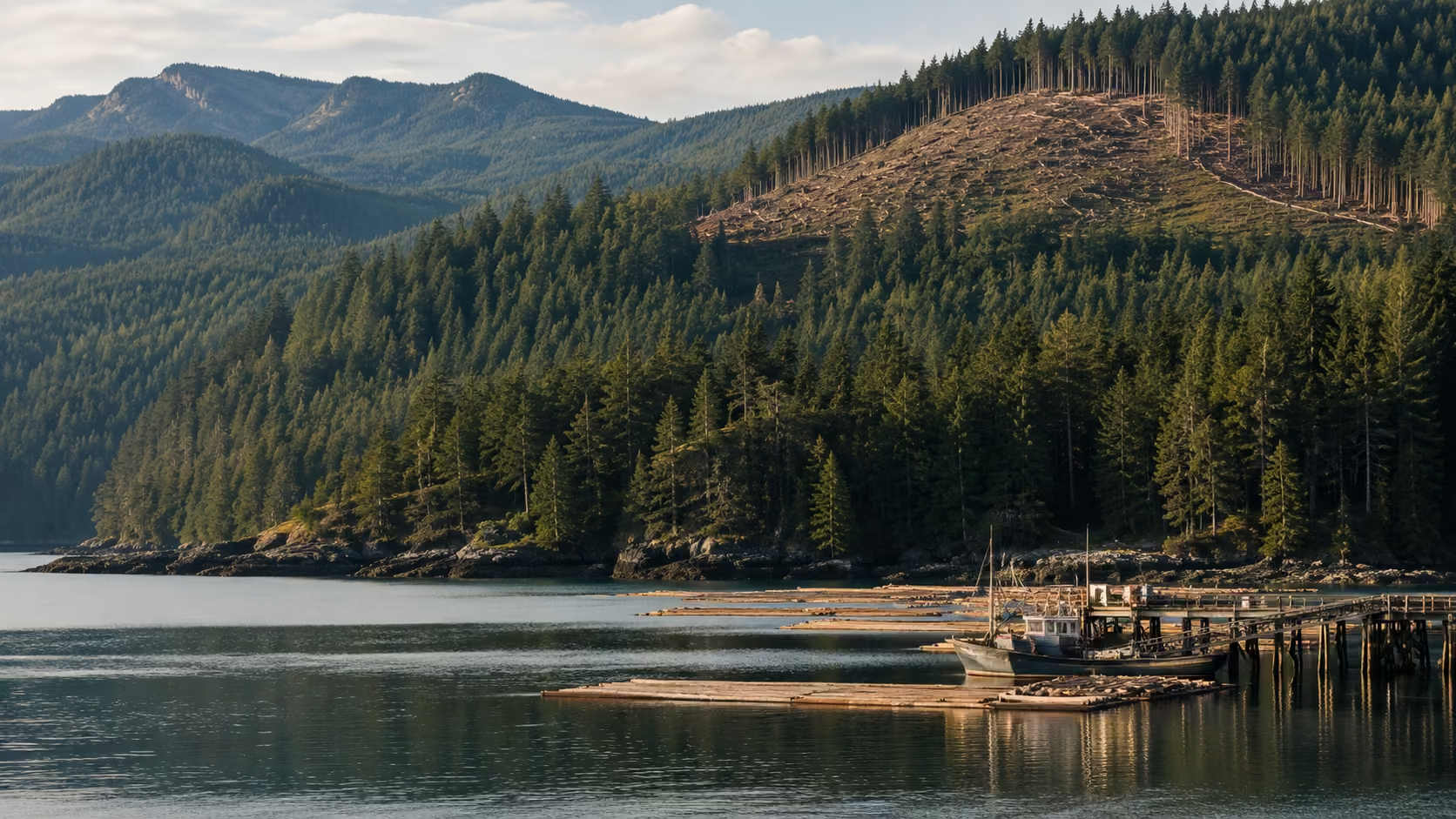
There is a log sort near the town of Sayward on Vancouver Island where the Kelsey Bay operation has processed millions of trees over the decades, each one departing across the ocean, as the Narwhal put it, never to return. Standing near that dock in the fall of 2025, Wei Wai Kum Chief Christopher Roberts said something that contained the entire weight of what this article is about: "We've seen our territories decimated."
And then his nation bought in.
In 2024, four nations on Vancouver Island, the Tlowitsis, We Wai Kai, Wei Wai Kum and K'ómoks First Nations, acquired a 34% interest in a new partnership with Western Forest Products for $35.9 million. The partnership covers 157,000 hectares of forest near Campbell River and Sayward with an allowable annual cut of over 900,000 cubic metres of timber per year. In the language of reconciliation, this is a historic win. In the language of forestry economics in 2025, it is also a $35.9 million bet on an industry that is shedding capacity, losing its primary export market, and drawing down a fibre base that took centuries to grow.
Both of those things are true at the same time. That tension is the whole story.
The fastest tenure transfer in BC history
First Nations in 1991 held less than 1% of BC's provincial logging tenure. For decades, the largest ten companies in the province controlled roughly 70% of the cut. The remaining fractions went to smaller operators, community forests, and individual licences, with First Nations largely excluded despite the fact that essentially all of BC's productive forests sit on their unceded or treaty territory.
That has been changing. First Nations' share of BC's logging allowance jumped from 10% to 20% in just four years, and the Ministry of Forests' own budget notes describe the pace of tenure transfers as "occurring at a faster rate than anticipated." The Klahoose Nation has become one of the province's largest First Nations tenure holders. The Vancouver Island four-nation deal added 900,000 cubic metres of annual allowable cut to First Nations hands in a single transaction. Tenure transfers that would have taken a decade to negotiate a generation ago are now moving in months.
The driver is partly DRIPA, BC's Declaration on the Rights of Indigenous Peoples Act, passed unanimously in 2019 and subsequently described as establishing UNDRIP as the province's framework for reconciliation. And then in December 2025, the BC Court of Appeal went further: a landmark ruling found that UNDRIP is not merely aspirational policy in BC law but is legally enforceable. First Nations may now be entitled to raise UNDRIP rights if they are not adequately consulted on natural resource projects within their territory. The ruling sent the Premier scrambling to propose amendments that would suspend parts of DRIPA while the government appeals. That fight is unresolved.
What is clear is that the legal terrain beneath BC's forestry industry shifted fundamentally in December 2025, and that shift makes First Nations tenure security more durable, not less, than anything corporate tenure holders enjoy.
What they are actually acquiring
This is where the optimism has to slow down.
A forestry tenure is a right to harvest a specified volume of timber annually from a defined area of Crown land. It sounds like an asset. In a healthy market with abundant fibre, it is an excellent asset. In BC in 2025, it is increasingly a right to compete for a shrinking pool of economically viable timber in a market where the primary buyer just erected a 45% tariff wall, where two decades of wildfire and beetle kill have depleted the high-quality old growth that made BC's lumber industry what it was, and where the mills that process the timber are closing faster than new ones can be built.
Garry Merkel, a professional forester and member of the Tahltan Nation who co-chaired BC's Old Growth Strategic Review, described the position some First Nations now find themselves in with a phrase that stays with you: "They're bound economically." They paid for tenures in a distressed market. To service the acquisition costs and meet community obligations, they need to log. But the high-value, big-tree forests that justified the investment are increasingly gone. What is left is harder to harvest, yields less per cubic metre, and attracts lower prices in a market that already does not pay enough to keep cash-positive.
This is not unique to First Nations. It is the structural reality of BC forestry for all tenure holders right now. But for corporate operators, the response is well-documented in this series: shed the BC exposure, restructure toward US operations, return capital to shareholders, and wait for the cycle to turn. First Nations do not have that option. Their relationship to their territory is not a portfolio allocation. Walking away from the Sayward watershed is not a strategy that Wei Wai Kum considers.
Revenue sharing goes the other direction
At the exact moment First Nations are acquiring more timber tenure, the government cheques that supplemented their forestry income are shrinking.
BC began sharing forestry revenues with First Nations in the early 2000s. The payments were tied to the value of logging activity in a nation's territory. As logging declines across the province, those revenue shares decline too. BC warned explicitly that forestry revenue sharing with First Nations would see its first major decline beginning in 2025. More tenure. Less revenue sharing. The two trends are moving in opposite directions simultaneously.
The province has framed this as an acceptable trade-off: more ownership is better than more cheques. That framing is defensible in the long run. It is harder to defend in the short run when communities are trying to fund health programs, housing, and language revitalization from an industry in structural distress.
The deeper problem is that revenue sharing was never a solution. It was compensation for the loss of something that could not be replaced. Old growth forests cut over the past century are not coming back on any timeline that matters to the communities that lived among them. What First Nations are acquiring now is the right to manage what is left of a depleted system, and to build a different kind of relationship with it going forward. That can be more valuable than what came before. But it requires capital, policy support, and time that the current moment does not readily supply.
The legal ground under everyone's feet
The December 2025 court ruling on DRIPA has introduced a new variable into every forestry transaction in BC. The decision found that First Nations may raise UNDRIP rights against provincial laws that affect their territories, not just against individual project approvals. That is a much broader legal tool than what existed before. A First Nation that previously could object to a specific logging operation can now potentially challenge the statutory framework that enables logging in their territory at all.
This matters for the mass timber ambition laid out in this series. If domestic CLT manufacturing is going to scale using BC fibre, it needs a stable, predictable supply of structurally graded timber over a 20 to 30 year horizon. That kind of supply certainty is increasingly dependent on First Nations consent, not just Crown approval. A mill that invests $40 million in precision manufacturing equipment needs to know that its fibre supply will not be disrupted by litigation. The most reliable way to guarantee that is to have First Nations as equity partners in the entire chain: the forest, the tenure, the mill, the product.
That is the vision. It exists as policy language in several government documents. It is beginning to exist in reality in a handful of places.
The Okanagan thread and what it looks like on the ground
The most tangible expression of this transition near Kelowna is not in forestry at all. The Tolko mill in Kelowna's North End closed permanently in 2020. That 43-hectare former industrial site is now planned for 3,500 housing units under the city's North End Area Redevelopment Plan, with community consultation ongoing and concept drawings showing towers, mid-rises, and public space where a sawmill operated for nearly a century.
The land has its own history in terms of whose territory it sits on. As it transitions from lumber production to housing production, the question of Indigenous participation in that transition is not peripheral. It sits at the centre of what reconciliation in the built environment actually means.
Thirty minutes south, in Penticton, Greyback Construction is converting a different former mill site into a prefabricated housing factory using BC wood. In Nelson, Spearhead Timberworks operates in a region where Kalesnikoff Mass Timber, a company with deep ties to the Kootenay community, supplies CLT panels from locally sourced Interior fibre. The Kootenay region is explicitly positioning itself as a hub for BC's mass timber economy, with a network of sawmills, value-added manufacturers, and training programs at Selkirk College working in coordination.
The BC government sent its largest-ever forestry trade mission to Japan and South Korea in November 2025. The BC First Nations Forestry Council CEO was in the delegation. Lenny Joe said: "As British Columbia's forest economy transforms, First Nations are transforming with it." That sentence is aspirational and honest at the same time. The transformation is real. Its direction is not yet determined.
The path where this goes well
The most viable long-term scenario for First Nations forestry in BC is not commodity lumber. It is selective, high-value harvest feeding domestic CLT and glulam manufacturers, with carbon credits from the standing timber that is not harvested, and equity stakes in the manufacturing facilities that convert that timber into structural building products.
Coastal First Nations have already pioneered this model in the Great Bear Rainforest, where a revenue-sharing agreement gives member nations the ownership and right to sell carbon offsets from forests in their territories, described as the first of their kind in BC and worldwide. That model, applied to the BC Interior, would connect First Nations timber tenure with carbon markets, domestic CLT manufacturing demand, and Build Canada Homes procurement in a single integrated value chain.
Some BC First Nations are already thinking this way. A leader of the Skeetchestn Indian Band told the Globe and Mail that his nation might decide it made more economic and environmental sense to leave forests standing and sell carbon credits, rather than harvest lumber. That is not a romantic aspiration. It is a calculation about where value is going in a world that is pricing carbon and building with wood.
Three scenarios, one unresolved story
This series has traced the lumber paradox from its origins in a 40-year trade war through corporate restructuring, construction cost reality, the prospects for a new trade deal, the global mass timber market, and now to the question of who will actually own the land beneath all of it.
Three scenarios are visible from here, and this article is honest enough to say that the series does not know which one arrives.
In the first scenario, a new Canada-US Softwood Lumber Agreement is reached through the 2026 USMCA review or shortly after. The export door reopens, commodity lumber flows south again at reduced tariffs, and the urgency around domestic mass timber and the Buy Canadian pivot diminishes. First Nations tenure holders pivot back to commodity logging to service their acquisition costs. The structural problems of fibre depletion and mill obsolescence persist, but the pressure is lower. This is everyone's comfort zone. It may not be achievable.
In the second scenario, no deal is reached. Domestic mass timber manufacturing scales successfully over three to five years with sustained government procurement through Build Canada Homes, private capital following the government mandate, and First Nations timber tenure becoming the stable, rights-secured fibre base that CLT manufacturers need. First Nations capture value from tree to building, the Okanagan and Kootenay Interior become manufacturing hubs, and the industry that decimated those territories for a century becomes, in a different form, the foundation of an economy that serves those territories' people. This is the aspiration. It requires capital and political will across multiple election cycles.
In the third scenario, fibre depletion accelerates faster than the mass timber transition can scale. More mills close. More communities hollow out. First Nations who paid for tenures find themselves holding rights to harvest timber that is too expensive to reach, in a market that does not pay enough to justify reaching it, with government revenue sharing declining and carbon credit markets still too nascent to fill the gap. The assets become liabilities. The communities that needed the most support end up holding the concentrated cost of a collapse they did not cause.
The third scenario is underweighted in current policy language. Almost every government announcement focuses on scenarios one or two. The fibre depletion data, the rate of mill closures, and the gap between mass timber manufacturing ambition and actual capital investment suggest that scenario three deserves more serious attention than it is receiving.
The final article in this series publishes in October 2026, after the August duty determination, the USMCA review outcome, and Build Canada Homes' first full operational year.
The content of this article is for informational purposes only and should not be considered as financial, legal, or professional advice. Coldwell Banker Horizon Realty makes no representations as to the accuracy, completeness, or suitability of the information provided. Readers are encouraged to consult with qualified professionals regarding their specific real estate, financial, and legal circumstances. The views expressed in this article may not necessarily reflect the views of Coldwell Banker Horizon Realty or its agents. Real estate market conditions and government policies may change, and readers should verify the latest updates with appropriate professionals.