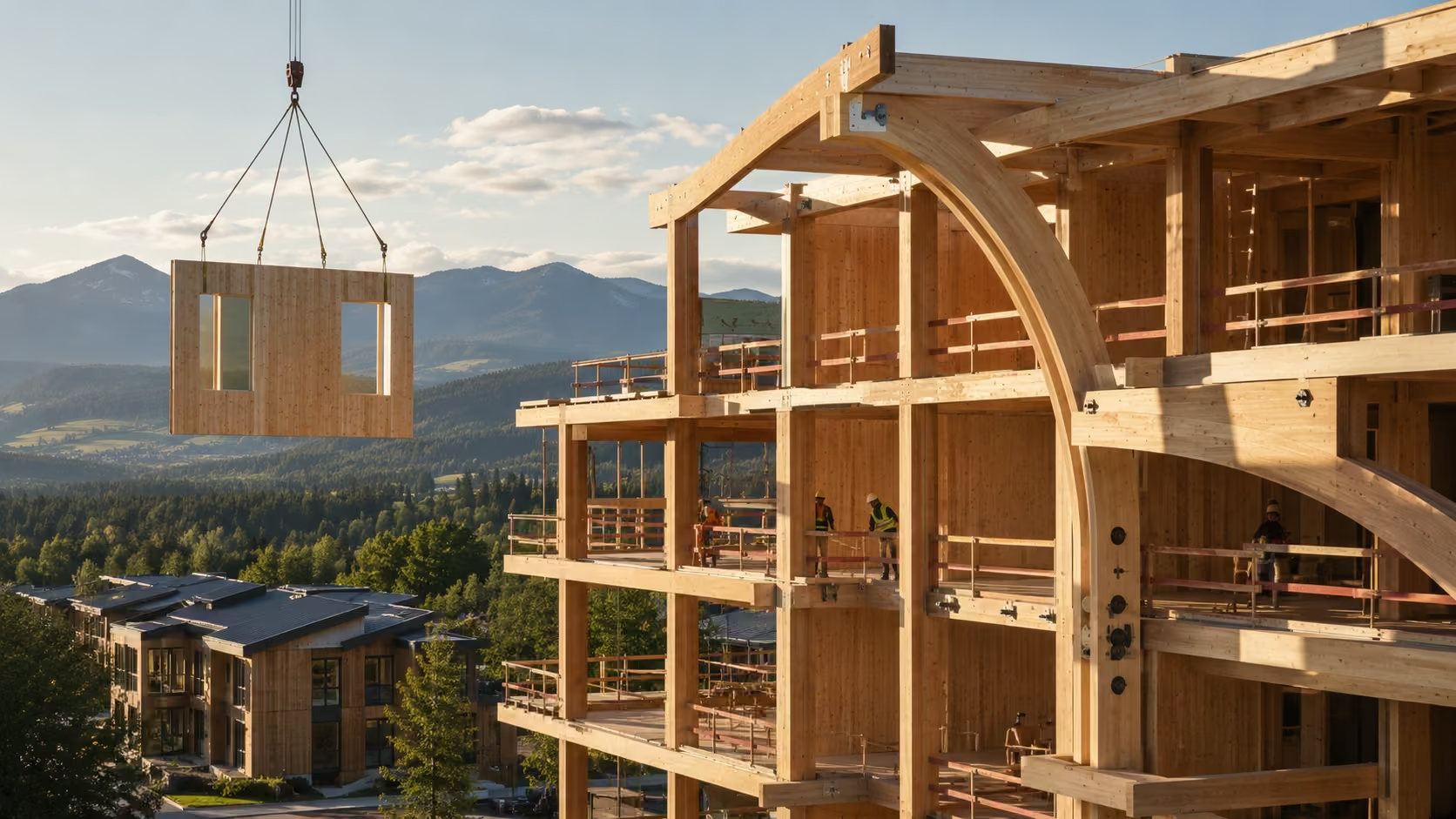
May 14, 2026, the federal government announced a $12.4 million investment in 14 forestry projects across British Columbia. One of them was Spearhead Timberworks in Nelson, receiving $7.5 million to build a new facility capable of manufacturing curved and double-curved glulam components from locally sourced BC wood. Another was a project in Burns Lake, led by Yinka Dene Economic Development, a First Nations-owned enterprise, to produce wood fibre insulation and packaging materials from species previously considered unusable waste fibre.
Both of these things matter. But they also illustrate the gap between what Canada's mass timber ambition looks like in a press release and what it looks like at scale. Seven and a half million dollars for a specialized curved glulam facility in a town of 10,000 people is a real investment in a real company doing genuinely innovative work. It is also roughly the cost of a single modest apartment building in Vancouver. Canada's share of the global CLT market is not yet proportional to its forests, its species quality, or its policy ambition.
This is the article about what the opportunity actually is, why Canada is unusually positioned to capture it, and why the window is narrower than the government's language tends to suggest.
What mass timber actually is, and why the world is suddenly interested
Cross-laminated timber, or CLT, is not a new material. Austrian and German engineers developed it in the early 1990s as a way to create structural panels from smaller-dimension timber by gluing alternating layers at perpendicular angles. The result is a panel that behaves more like concrete or steel in terms of structural performance, can be prefabricated to precise dimensions off-site, and stores carbon rather than emitting it. A CLT building is essentially a very large, very flat-packed piece of furniture assembled on-site, except that the flat-packed pieces weigh several tonnes and form the structural skeleton of a 12-storey building.
Europe figured this out early. Austria and Germany have been building with mass timber at commercial scale since the 1990s, and the manufacturing base there, companies like Binderholz, KLH Massivholz, and Stora Enso, is now 30 years deep. According to Art Schmon, VP Mass Timber at Forest Economic Advisors and lead author of FEA's Global Mass Timber Service, Europe currently holds approximately 87% of the global CLT market, not the 54% figure that circulates widely in SEO-optimized market research reports. Using global CLT production of around 2.18 million cubic metres at an estimated average price of CAD $1,500 per cubic metre, total global revenue is in the range of $3.3 billion, though Schmon notes this carries a variance of plus or minus 10% given that 103 of 104 CLT manufacturers worldwide are private companies that do not publish revenue figures. That is not a niche material finding a niche market. That is an established product with a structural tailwind behind it, and one that Europe has an overwhelming head start in supplying.
The tailwind is decarbonization. Construction accounts for roughly 40% of global carbon emissions. Steel and concrete are among the most carbon-intensive industrial processes on earth. Mass timber, by contrast, sequesters carbon in its panels for the life of the building, and its manufacturing process emits a fraction of what steel or concrete requires. As governments worldwide legislate carbon targets into building codes and procurement rules, mass timber moves from a boutique architectural preference to a structural requirement. North America is now the fastest-growing region for CLT adoption. And the US, Canada's largest potential market by volume, has a structural reason to prefer Canadian-origin spruce over European imports: geography.
Why Canada is actually well placed
Spruce-pine-fir, the species group that defines BC's Interior forests, happens to be one of the best raw materials for CLT manufacturing. Canadian spruce is well-regarded for its consistent grain structure, its dimensional stability after kiln-drying, and its strength-to-weight ratio. The very species that BC's mills have been processing into commodity framing lumber for a century is among the world's preferred raw materials for the most important growth category in the global engineered wood market.
BC also moved on building codes earlier than most. As of April 2024, encapsulated mass timber construction up to 18 storeys is now permitted across British Columbia, making it one of the most permissive jurisdictions in the world for tall wood buildings. The Canadian Wood Council called it "tremendous potential to strengthen the BC economy by using BC forest products and workers to build much needed affordable housing." That code reform matters because it creates domestic demand, which creates a market, which justifies factory investment.
The government has been piling in behind this. Ken Kalesnikoff of Kalesnikoff Mass Timber, a company based in Nelson that has spent three decades refining its manufacturing processes, was appointed to co-lead the Canadian Forest Sector Transformation Task Force, the 90-day group charged with charting the industry's future. That appointment signals clearly where Ottawa thinks the forest sector's growth is. Build Canada Homes has a statutory mandate to prioritize mass timber and Canadian materials in all federal housing construction. Japan, which imported approximately $890 million of BC forestry products in 2024, is actively expanding mass timber adoption in public buildings and housing. South Korea's largest housing developer, the Korea Land and Housing Corporation, is already exploring mass timber as a low-carbon alternative to concrete. BC sent its largest-ever forestry trade mission to Japan and South Korea in November 2025, with over 60 delegates and signed agreements with Japanese and Korean partners on wood building systems.
And the Okanagan is becoming a specific node in this transition. In Penticton, Greyback Construction is converting a former mill site into a prefabricated housing factory, using BC wood to build wall panels and floor assemblies off-site. In Nelson, Spearhead Timberworks is expanding into international-grade curved glulam manufacturing. Kalesnikoff's own CLT plant, also near Nelson, has been supplying projects across North America for years. The Kootenay region is not positioning itself as the next industrial centre for commodity lumber. It is positioning itself as the next industrial centre for precision-engineered wood.
The honest competitive picture
Europe has a 30-year head start. This is not a minor disadvantage.
Austrian and German CLT manufacturers have established export relationships with customers across Asia, the Middle East, and increasingly North America. They have supply chains, quality certifications, and design ecosystems built around their products. Stora Enso, one of Europe's largest forest products companies, invested in Element5, a mass timber producer in St. Thomas, Ontario, becoming the first major European company to directly support North American mass timber manufacturing expansion. That is not a company conceding the North American market. It is a company hedging into it.
Canada's geographic advantage for the US market is real. Shipping CLT panels from Austria to Chicago is expensive. Shipping from BC or Ontario is significantly less so. For the US housing market, which represents Canada's largest potential demand pool, proximity matters. Canada's mass timber roadmap, developed by the Transition Accelerator, projected that if Canadian manufacturers could capture just 25% of projected US demand by 2030, that would translate to roughly 735,000 cubic metres of exports annually, more than double Canada's current total mass timber production.
But capturing that requires manufacturing capacity that does not yet exist at scale. Less than 1% of Canada's softwood lumber currently goes toward mass timber manufacturing. The mills that exist, and there are only a handful with serious CLT capacity, are small relative to the market they would need to serve. The Spearhead investment is meaningful. Kalesnikoff is genuinely world-class. But neither of them, nor all of the BC Interior's mass timber companies combined, yet constitutes a supply chain capable of competing with European volume at North American scale.
The bigger problem is that the companies who could make that capital investment quickly are the large commodity producers, West Fraser, Canfor, Interfor, and they are currently shedding BC exposure and investing in US South commodity mills. As one industry analysis noted bluntly: without major forestry firms treating mass timber as a core business, Canada risks falling behind. The boutique specialists are doing exceptional work. They are not at the scale the opportunity requires.
The fibre problem does not go away
And then there is the tree problem, which sits beneath the manufacturing problem and does not yield to policy announcements.
CLT requires structurally graded, kiln-dried timber in consistent dimensions. It is more demanding raw material than commodity framing lumber. And BC's fibre supply has been declining structurally for two decades: beetle kill, wildfire losses, Indigenous rights settlements reducing harvesting in certain areas, and AAC reductions across dozens of timber supply areas. The Wood Pellet Association of Canada reported in 2025 that BC's fibre supply has declined more than 40% since 2018.
Mass timber uses lumber more efficiently than commodity production: a precision-cut CLT panel wastes less material per unit of structural output than a standard framing lumber run. Efficiency gains are real. But a 40% decline in available fibre is not a problem you solve with more efficient cutting. It is a supply constraint that limits the ceiling of what any domestic manufacturing expansion can achieve.
The Transition Accelerator's mass timber roadmap set a target of 1 million cubic metres of Canadian mass timber production by 2030 and 2 million by 2035. The current production is somewhere around 200,000 cubic metres. Getting from 200,000 to 1,000,000 in four years, while building factories, training a workforce, establishing quality systems, and competing for the same fibre base that commodity sawmills are already bidding for, is an aggressive trajectory even in an optimistic scenario.
What this means for housing costs and the real estate market
Build Canada Homes has committed to a specific claim: mass timber modular construction can cut building timelines by up to 50% and reduce costs by as much as 20%, compared to conventional stick-frame and concrete construction. If that claim holds at scale, it is the most significant construction productivity improvement Canada has available. Not a 3% reduction from cheaper lumber, but a 20% reduction from rebuilding how houses are assembled.
The catch is that the claim requires the manufacturing base to exist. Factory-built modular mass timber is faster and cheaper when you have factories. Before the factories are built and the supply chains are established, it is more expensive and slower than conventional construction, because every project involves custom engineering and procurement from a handful of small-volume specialists.
This is the right long-term direction. The decarbonization case, the speed case, and the supply security case all point the same way. Canada has species advantages, code advantages, and government demand mandates that no other country outside Europe can match. The question is whether the capital to build the manufacturing base arrives fast enough, from sources large enough, to turn a sector of genuinely promising boutique companies into the backbone of a Canadian housing construction supply chain.
The next article in this series looks at the layer beneath all of it: who will actually own the timber that feeds these factories. BC's forests are quietly changing hands, and the answer to that question shapes everything else.
The content of this article is for informational purposes only and should not be considered as financial, legal, or professional advice. Coldwell Banker Horizon Realty makes no representations as to the accuracy, completeness, or suitability of the information provided. Readers are encouraged to consult with qualified professionals regarding their specific real estate, financial, and legal circumstances. The views expressed in this article may not necessarily reflect the views of Coldwell Banker Horizon Realty or its agents. Real estate market conditions and government policies may change, and readers should verify the latest updates with appropriate professionals.