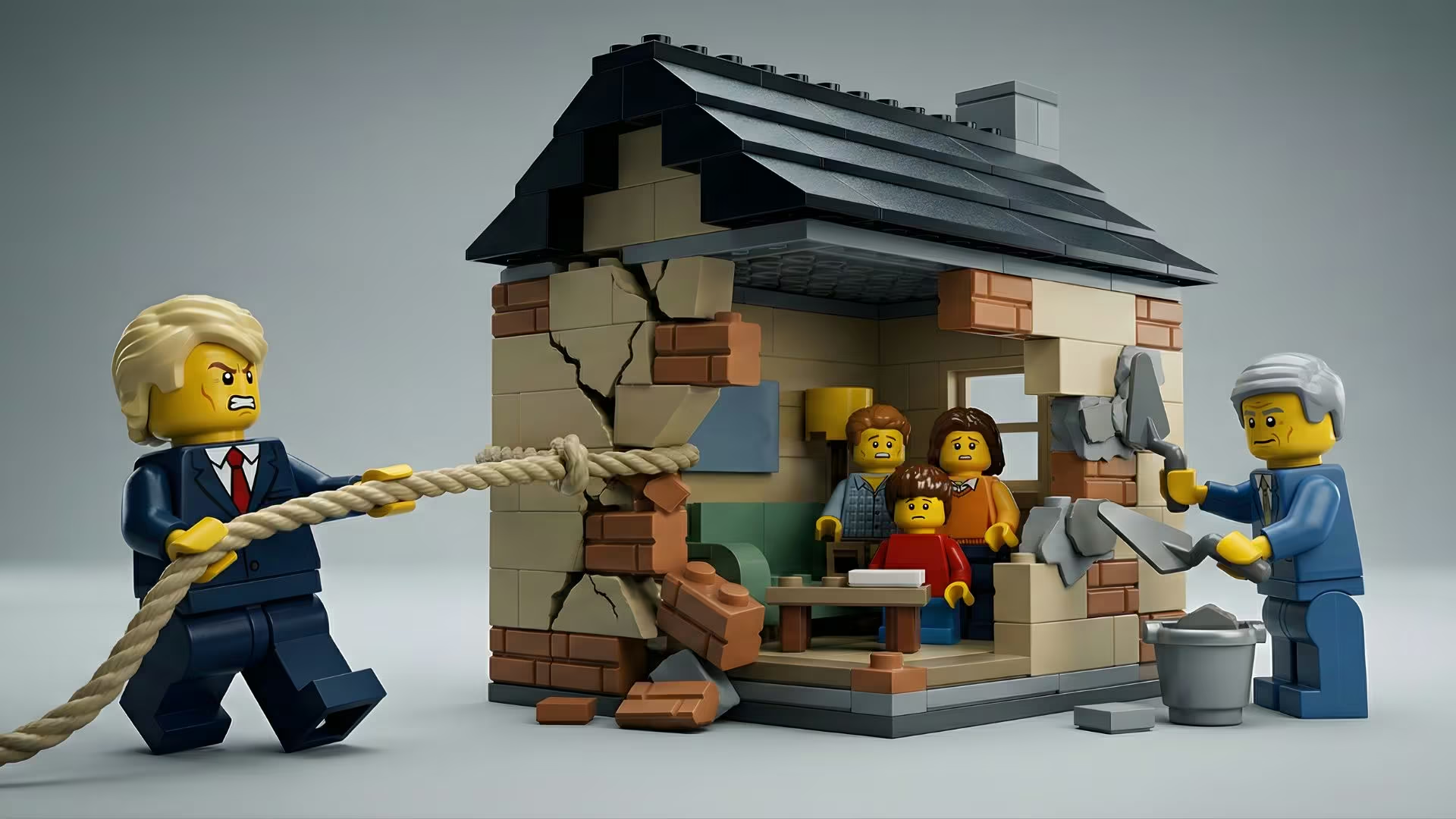
A week ago, Donald Trump praised Mark Carney for making a trade deal with China. This weekend, he threatened to slap a 100% tariff on all Canadian goods if that deal moves forward.
The whiplash is exhausting. But for anyone watching the housing market, it's also becoming predictable. Every time trade tensions escalate, buyers freeze. Construction costs climb. And what looked like a recovery starts feeling like wishful thinking.
Canada's housing market spent most of 2025 trying to bounce back from years of affordability pain. Lower interest rates were supposed to help. Pent-up demand was real. But tariff uncertainty kept pulling the rug out, and now we're heading into 2026 with the same cloud hanging over everything.
What Trump Said (And Why It Matters)
On Saturday, Trump posted on Truth Social that Canada would face a 100% tariff if it "makes a deal with China." He specifically called out Carney, saying Canada was "sorely mistaken" if it thinks it can become a "drop off port" for Chinese goods heading to the US.
This comes after Canada and China reached a preliminary agreement earlier this month. Beijing cut tariffs on Canadian agricultural products like canola oil (from 85% to 15% starting March 1), while Ottawa increased quotas for Chinese electric vehicles at a 6.1% tariff rate, up from the previous 100% tariff imposed in October 2024.
It's not a full free trade agreement. Carney made that clear on Sunday, stating Canada has "no intention" of pursuing one. But the damage to market confidence might already be done.
The thing is, this isn't just political theater. Trump already raised tariffs on Canadian goods to 35% in August 2025, up from 25%. Some products, steel and copper and certain auto parts, already face US tariffs even under the Canada-US-Mexico Agreement. A 100% tariff would be catastrophic for the Canadian economy, and housing markets don't do well when the economy is in crisis.
2025 Was Supposed to Be Different
Remember January 2025? The Canadian Real Estate Association was forecasting an 8.6% increase in home sales for the year, with average prices climbing 4.7% to around $722,000.
That didn't happen.
Instead, tariff uncertainty froze buyers in place. By March, home sales had fallen 9.3% year-over-year, and the national average price had dropped 3.7% to $678,331. CREA's revised forecast shows sales declining 0.2% for the year, with the national average price falling slightly to $687,898.
"In short order we've gone from a slam dunk rebound year to treading water at best," CREA senior economist Shaun Cathcart said in April.
That's the polite version. The reality is harsher. Markets don't like uncertainty, and we've had nothing but uncertainty since Trump took office.
How Tariffs Actually Hit Housing Markets
The connection between tariffs and housing isn't always obvious, but it's direct. Here's how it works.
First, construction costs go up. Tariffs on steel, lumber, copper, and other building materials make new homes more expensive to build. The National Association of Home Builders estimated that tariffs could add nearly $9,000 to the cost of building a single-family home. In Canada, where building material prices climbed through the pandemic and never really came back down, that's a problem we can't afford.
Second, job losses spook buyers. When tariffs threaten major industries, automotive, manufacturing, agriculture, people worry about their employment. TD's chief economist predicted the economy could shed another 100,000 jobs through 2025 if trade tensions continued. Unemployed people don't buy houses. People worried about becoming unemployed don't buy houses either.
Third, economic uncertainty pushes buyers to the sidelines. This is the softest impact but maybe the most damaging. Even people with secure jobs and solid finances hesitate when they don't know what the economy will look like in six months. Why commit to a 25-year mortgage when a recession might be around the corner?
"Markets don't like uncertainty, and we're seeing that sentiment manifest in a quieter-than-normal spring market," Don Kottick, president of REMAX Canada, said in May. He noted that trade uncertainty kept the market in a holding pattern through 2025, with many buyers staying on the sidelines.
That pattern hasn't changed. If anything, it's gotten worse.
Regional Differences Matter
Not every market is suffering equally. BC and Ontario, the provinces with the highest prices and tightest markets, took the biggest hits in 2025. TD Economics now forecasts a 3.2% drop in average home prices for Canada overall, with steeper declines in those two provinces.
The Toronto condo market has been "particularly soft," dragging down Ontario's average. BC's sales remained below their 10-year average through most of the year.
Meanwhile, the Prairies are holding up better. Alberta, Saskatchewan, and Manitoba benefit from comparatively better affordability and tighter supply-demand relationships. These markets are still growing, though even their forecasts have been marked down from earlier predictions.
The Okanagan sits somewhere in between. We're not as exposed as Vancouver or Toronto, but we're not immune either. Buyers here feel the same uncertainty everyone else does. When the national economy wobbles, local markets notice.
The Bank of Canada's Impossible Position
Here's where things get complicated. The Bank of Canada has cut interest rates by 275 basis points since June 2024, bringing the policy rate down significantly. Those cuts helped pull mortgage rates lower, which should have brought buyers back.
But tariffs create inflationary pressure. When imports get more expensive, prices rise across the economy. If inflation climbs, the Bank of Canada might have to pause rate cuts or even reverse course, even as the economy weakens.
That's the worst possible scenario: rising inflation, rising unemployment, and higher interest rates all at once. It's called stagflation, and it's brutal for housing markets.
CMHC warned in its summer 2025 outlook that trade tensions would push inflation back above 3% by mid-2026, while unemployment ticks higher. Mortgage rates would stay elevated despite policy rate cuts, because bond yields (which drive fixed mortgage rates) would remain high.
The result? "A near-term environment where many households are still priced out and builders are hesitant to break ground."
What About 2026?
Carney's response to Trump's threat was measured. Canada won't pursue a full free trade agreement with China. The preliminary deal is about domestic markets, not creating a backdoor for Chinese goods into the US. Whether that's enough to satisfy Trump is anyone's guess.
The optimistic view is that this blows over like previous threats have. Trump makes noise, Carney holds firm, and eventually some compromise emerges that lets everyone save face. In that scenario, housing could still recover in 2026. Lower rates, pent-up demand, and normalizing inventory would drive a modest rebound.
The pessimistic view is darker. If Trump follows through with punitive tariffs, whether 100% or something lower but still severe, Canada's economy takes a serious hit. Job losses mount. Recession fears become recession reality. Housing demand craters, and prices drop further.
Most forecasts split the difference. CMHC expects housing activity to improve gradually through 2026, assuming trade tensions ease somewhat. RBC frames the year around whether Trump's tariff agenda escalates or moderates. TD assumes six months of heavy tariffs before negotiations lead to improvement.
Nobody's making confident predictions right now. The word you hear most often is "depends."
What This Means for Buyers and Sellers
If you're thinking about buying in the next few months, the uncertainty cuts both ways. On one hand, buyer hesitation means less competition and more negotiating power. Listings are up, prices have softened in many markets, and mortgage rates are lower than they were a year ago.
On the other hand, buying during economic uncertainty is risky. If tariffs hit hard and the job market weakens, you might find yourself carrying a mortgage through a recession. That's not a decision to make lightly.
For sellers, timing matters more than usual. If trade tensions ease and buyer confidence returns, you could catch a spring bounce. If things deteriorate, waiting might mean watching your home value slide.
The frustrating reality is that the housing market right now depends more on what happens in Washington than what happens in Ottawa or at the Bank of Canada. Trump's trade policy is the single biggest variable hanging over Canadian real estate, and predicting what he'll do next is impossible.
The Bigger Picture
This isn't just about one tariff threat. It's about a pattern that's now 18 months old. Since Trump was elected in late 2024, Canada's housing market has been stuck in a holding pattern. Every time momentum builds, trade tensions flare up and knock it back down.
CMHC's February 2025 outlook warned that "some level of tariffs will remain in the coming years." The uncertainty and confusion around trade policy has already weighed on business confidence and slowed investment. Those headwinds aren't going away anytime soon.
Canada needs more housing. Everyone agrees on that. But building more housing requires stable economic conditions, predictable costs, and consumer confidence. Tariff chaos undermines all three.
Developers hesitate to break ground when material costs are volatile. Buyers hesitate to commit when job security feels shaky. Lenders get cautious when the economic outlook is murky. The whole system slows down.
We're caught in a loop where trade politics keep derailing what should be a straightforward housing recovery driven by lower rates and real demand. Until that changes, forecasts will keep getting revised downward and the word "depends" will keep showing up in every market analysis.
Whether you're planning to buy, sell, or just waiting to see what happens next, understanding how tariff uncertainty affects local markets is crucial right now. The Okanagan's housing landscape in 2026 will be shaped as much by decisions made in Washington as by anything happening here at home, and navigating that reality successfully means staying informed, realistic about risks, and ready to move when opportunities appear. If you're trying to make sense of what this all means for your specific situation, that's exactly the kind of local market expertise our team at Coldwell Banker Horizon Realty can help you work through.
The content of this article is for informational purposes only and should not be considered as financial, legal, or professional advice. Coldwell Banker Horizon Realty makes no representations as to the accuracy, completeness, or suitability of the information provided. Readers are encouraged to consult with qualified professionals regarding their specific real estate, financial, and legal circumstances. The views expressed in this article may not necessarily reflect the views of Coldwell Banker Horizon Realty or its agents. Real estate market conditions and government policies may change, and readers should verify the latest updates with appropriate professionals.