Location: 470 Queensway Avenue, Kelowna, BC | Admission: Adults $10, Students/Seniors $8, Youth (5-17) $7, Family $25, Under 5 free. Every second Sunday of the month is pay-what-you-wish. Indigenous visitors are admitted free of charge.
There is a particular kind of afternoon that Kelowna does better than most cities twice its size. It starts somewhere unremarkable, like deciding you need to get off the couch, and ends with you standing in front of a reconstructed underground winter dwelling thinking about the 10,000 years of human history sitting beneath the orchard-covered hillsides you drive past every day without a second thought.
That is the afternoon the Okanagan Heritage Museum delivers, reliably, for ten dollars.
What You Are Actually Walking Into
The museum sits at 470 Queensway Avenue, one block from Bernard Avenue and a short walk from the waterfront. It shares a building complex with the Okanagan Military Museum and is directly beside the Queensway Transit Exchange, which means you can arrive without a car and without circling a parking lot.
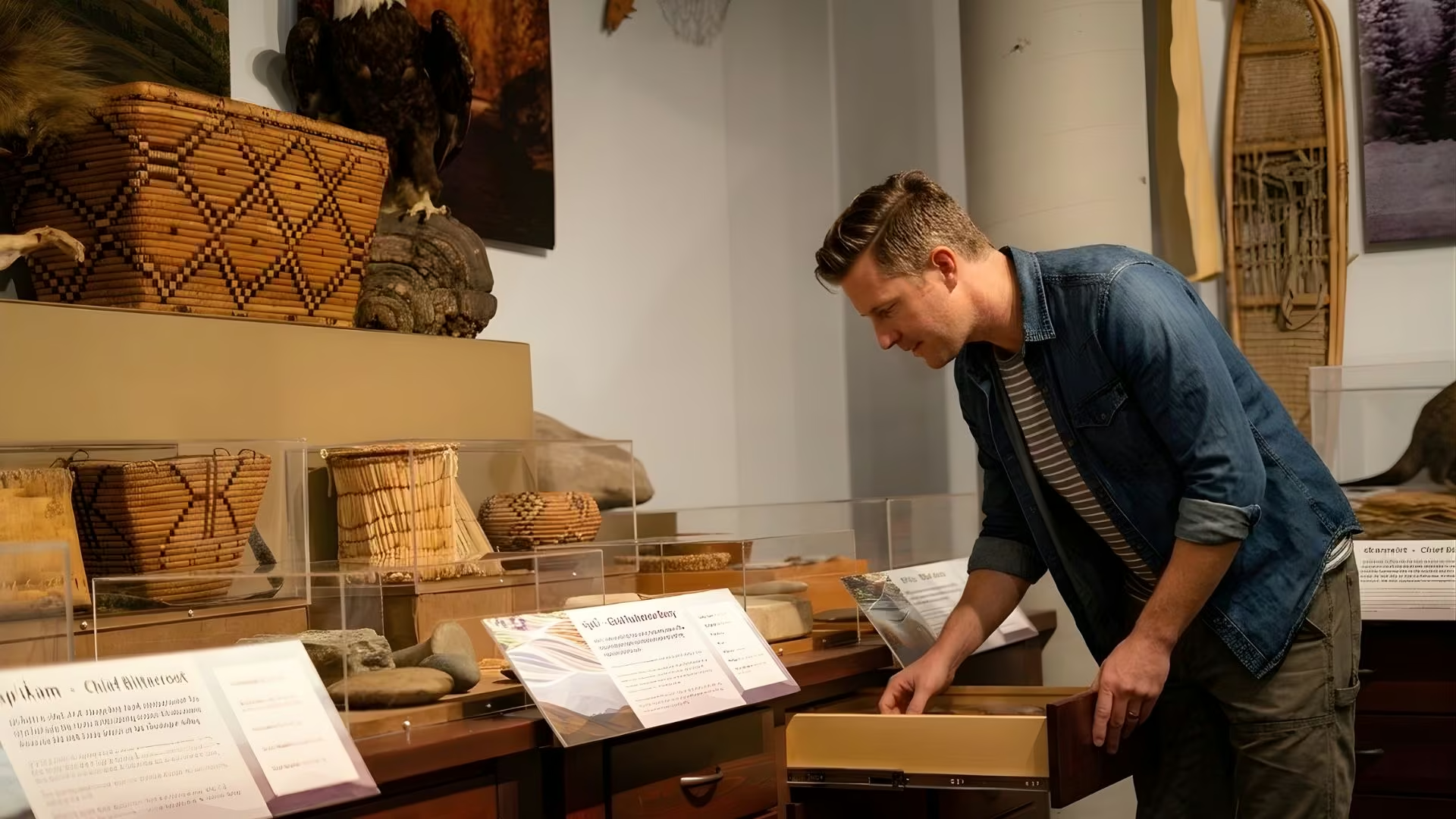
The permanent gallery was completely overhauled in 2019, a multi-year project built around the expertise of syilx/Okanagan Elders and knowledge carriers rather than the usual approach of historians working from the outside in. That distinction matters when you walk through it. The exhibits do not feel like a glass-case summary of someone else's culture. They feel like an invitation.
The first thing that stops most people is the qʷćiʔ, a traditional Okanagan winter home. Elder Eric Mitchell of the Okanagan Indian Band led its design and construction inside the museum. You step into it. The ceiling curves above you. It is dim and warm and genuinely beautiful in a way that no interpretive panel achieves on its own. Most visitors spend more time here than they planned to.
The Exhibits Worth Slowing Down For
After the qʷćiʔ, the gallery moves into the settler and trader period. One of the more striking stops is the reconstruction of a store from Kelowna's Chinatown, the kind of history that does not get much surface area in standard regional narratives. The display puts names and stories to a community that helped build this valley and was systematically pushed out of it. Worth reading slowly.
There is also the McDougall cabin, dated to 1860, one of the few surviving pre-1890 structures in the region, which served as a fur trading post. The museum also keeps a 1908 Tudhope-McIntyre Motor Buggy, donated in 1958 and restored in the 1980s, sitting in the collection. It looks exactly like something a person would have driven along a dirt road through an apple orchard when Kelowna was still figuring out what it was going to become.
The Central Okanagan Sports Hall of Fame lives inside the museum as well. If you have been to a Kelowna Rockets game and wanted more context on the region's athletic history, this is where it lives.
Rotating feature exhibits change throughout the year, so there is a genuine reason to come back more than once.
How to Structure the Afternoon
The museum runs about 90 minutes to two hours at a comfortable pace. It is not exhausting. It is the kind of experience that leaves room for the rest of the day, which is exactly why it works so well as a Saturday fixture rather than a once-a-year obligation.
The practical sequence most locals use: arrive mid-morning or early afternoon, walk through the permanent gallery without rushing, spend extra time in the qʷćiʔ and the Chinatown section, check whatever the rotating feature exhibit is, and then walk three blocks to Bernard Avenue for coffee or lunch.
The Kelowna Public Archives is also located inside the museum. If you are researching property history, family genealogy, or the development history of a specific neighbourhood, the Archives is a legitimate resource and one most residents do not know exists.
Parking is available at the Memorial Parkade at 1420 Ellis Street. The museum is also directly connected to transit if you want to skip the car entirely.
The Okanagan Lifestyle Hidden in Plain Sight
Most people who visit Kelowna for the first time come for the obvious things: the lake, the wineries, the heat. They leave with a general impression of a place built for vacation. What the Heritage Museum quietly argues is that this valley has cultural and historical depth that predates the tourist economy by several millennia.
The syilx people called this place home for thousands of years before the first orchards were planted. The Chinese labourers who worked the canneries and packing houses, the settler families who cleared land in the 1880s and 1890s, the athletes who built sports culture in a small inland city, they are all in this building. That is not a footnote to Okanagan life. That is Okanagan life.
Understanding where a place comes from changes how you read it when you walk outside.
Living Close Enough to Make This Routine
The museum's location is the part that a lot of people overlook when they think about Kelowna real estate. Downtown condos and townhouses along the Queensway and Bernard corridor put residents within easy walking distance of this kind of spontaneous afternoon, along with the waterfront, the Saturday farmers market, the Kelowna Art Gallery two blocks away, and the restaurant strip on Bernard Avenue.
Residents in Kelowna's Cultural District walk to restaurants, bars, cafes, and the waterfront without needing to plan around a car. That walkability is what makes a museum visit feel like a natural extension of a Saturday rather than a scheduled excursion. You do not drive to the Heritage Museum. You wander there.
Downtown Kelowna's condo market has expanded significantly in the last few years, with buildings like Brooklyn and Bertram on the Block adding density to the Bernard Avenue corridor. Living downtown puts residents in the center of everything, with dining, cultural attractions, and waterfront access all within walking distance. For buyers who want urban walkability without surrendering the Okanagan landscape, this pocket of the city is genuinely worth considering.
The valley's history did not start with the wine industry or the ski hills. It started here, in this land, and the museum on Queensway is one of the more honest and accessible ways to understand what the Okanagan actually is before it was discovered.
Interested in living within walking distance of Kelowna's cultural core? Contact Coldwell Banker Horizon Realty to explore downtown condo and townhouse listings in the Bernard and Queensway corridor.
Okanagan Heritage Museum: 470 Queensway Avenue, Kelowna. Open Monday to Saturday 10am to 5pm. Check kelownamuseums.ca for current hours, rotating exhibits, and events.
The content of this article is for informational purposes only and should not be considered as financial, legal, or professional advice. Coldwell Banker Horizon Realty makes no representations as to the accuracy, completeness, or suitability of the information provided. Readers are encouraged to consult with qualified professionals regarding their specific real estate, financial, and legal circumstances. The views expressed in this article may not necessarily reflect the views of Coldwell Banker Horizon Realty or its agents. Real estate market conditions and government policies may change, and readers should verify the latest updates with appropriate professionals.