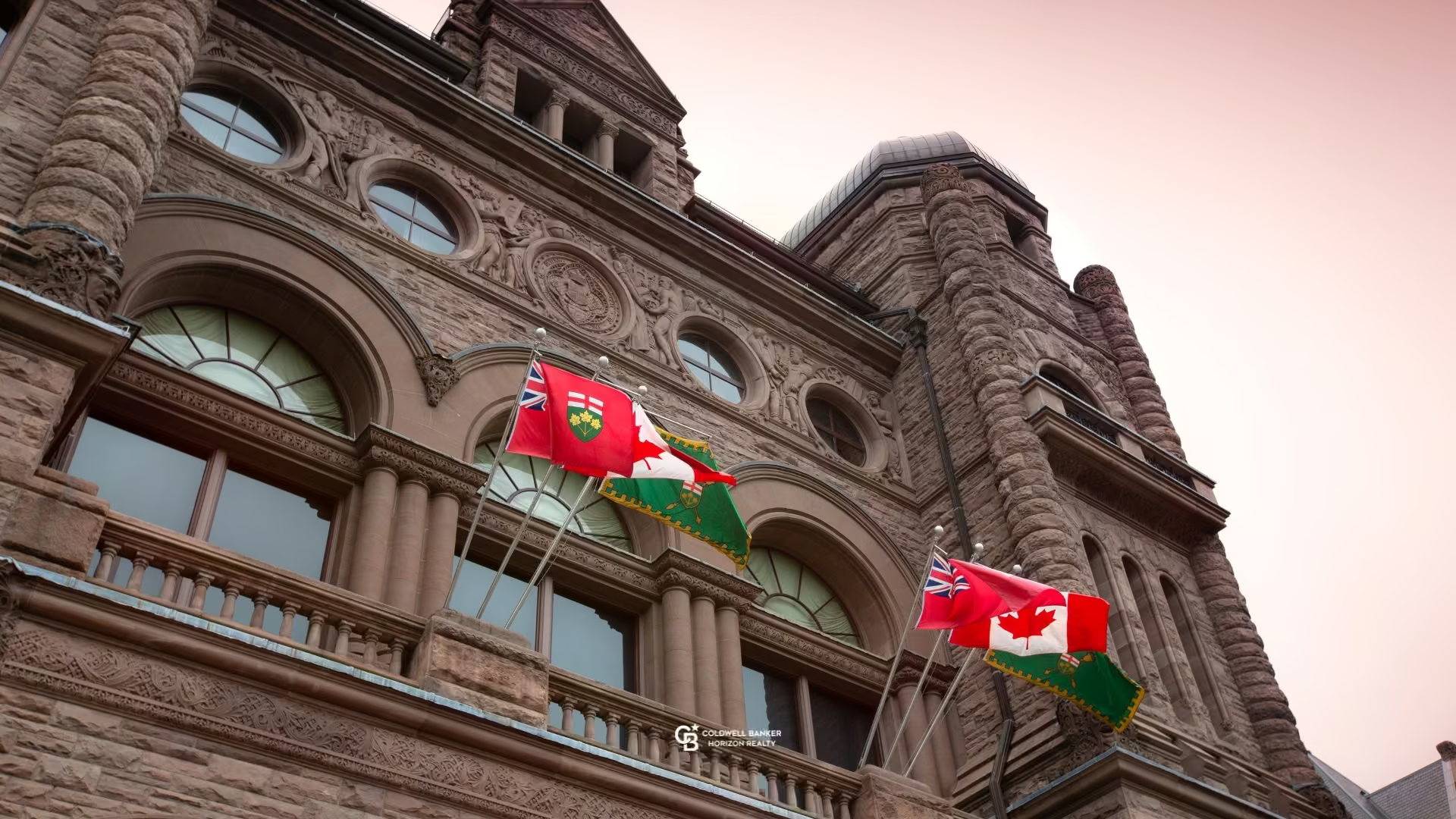
Ontario Premier Doug Ford stood in Mississauga on March 25, 2026, and announced something the province's battered housing construction industry has been asking for since 2022: the full 13% HST on new homes is going away for one year.
The measure is set to run from April 1, 2026 to March 31, 2027, and it applies to all buyers of qualifying new homes priced up to $1 million, for a maximum rebate of $130,000. That maximum holds through the $1.5 million mark, then phases down on a sliding scale to $24,000 for homes valued at $1.85 million. Homes above $1.85 million continue to qualify for the existing $24,000 provincial rebate. The rebate will be formally confirmed in the 2026 Ontario Budget, which drops March 26.
The federal government is in on it too, covering its share of the bill. The two governments are projecting a combined $2.2 billion in housing-related tax relief over the program's run.
How the Numbers Work
The math is more interesting when you break it down by price point. On a $700,000 new home, the full 13% HST comes to $91,000. Under the new program, that number goes to zero. On a $1 million home, the savings hit the maximum at $130,000. For a home at $1.75 million, sitting in the taper zone between $1.5 million and $1.85 million, the rebate is reduced proportionally, landing somewhere well above the $24,000 floor but below the ceiling.
Importantly, the rebate can be assigned to the builder at the point of sale. In practice, that means buyers don't have to come up with the full tax amount upfront and then wait for a refund. The builder factors the rebate into the purchase price, and the savings show up as a lower closing cost.
The Toronto Regional Real Estate Board confirmed that the relief extends to all buyers, not just first-timers, which is the key expansion from the fall 2025 announcement that had applied only to first-time buyers on homes under $1 million. This version covers anyone buying a qualifying new home regardless of ownership history.
BILD and the Ontario Home Builders' Association also noted that homes created through substantial renovations are treated as new housing for tax purposes, so the relief extends there as well. The existing New Housing Rebate and New Residential Rental Property Rebate frameworks remain in place.
The Market Context Behind the Policy
The timing isn't random. Ontario's new home construction sector has been in genuine trouble for years now, and the data is stark.
New home sales across Ontario fell to approximately 15,000 units in 2025, down from historic annual levels of 65,000 to 85,000 units. In the Greater Toronto Area specifically, total new home sales for the year hit just 5,314 units. Condominium apartment sales were down 89% from the 10-year average. CMHC has projected that Ontario's overall housing starts are on track to fall to near two-decade lows in 2026, driven by weak pre-construction demand and a pipeline that was already gutted by years of slow sales. When new home sales collapse today, construction collapses in three to five years. Ontario is now living through exactly that lag.
Government taxes, development charges, and other levies add hundreds of thousands of dollars to the cost of a new home before a builder pours a single foundation. As we covered in depth in The Hidden Tax on New Homes That Young Buyers Never See Coming, those costs compound at every level of government, and Ontario has accumulated some of the worst in the country. The HST on its own is one of the more visible and traceable components, which made it a natural target.
Ford's government has estimated the measure will add 8,000 housing starts over the next year and contribute $2.7 billion to Ontario's GDP while supporting up to 21,000 jobs. Those numbers come from provincial modeling, so treat them as directional. But the direction is plausible. When upfront costs drop by $130,000 on a qualifying purchase, buyers who had been sitting on the sidelines or who couldn't quite qualify run the numbers again.
What It Builds On and What Still Applies
This announcement layers on top of a series of overlapping federal and provincial moves over the past year.
In May 2025, the federal government announced a GST rebate for first-time buyers on new homes, and in March 2026, that $50,000 rebate became law when Bill C-4 received Royal Assent. That program applies to agreements of purchase and sale signed from March 20, 2025, through to the end of 2030. Ontario's prior fall 2025 announcement had removed the provincial HST portion for first-time buyers on homes under $1 million, and the province is now aligning its effective date with the federal government's March 20, 2025 date.
The new Ontario measure announced today is separate from and additional to those first-time buyer programs, and it runs through the April 1, 2026 to March 31, 2027 window regardless of whether the buyer is a first-timer. Construction timelines can extend as late as 2031 in some cases under the existing federal program.
For repeat buyers and move-up buyers purchasing new construction in Ontario, this is the first meaningful government-funded cost reduction they've had access to.
The Caveats Worth Knowing
A few things to keep in mind before calculating your savings.
The rebate is structured as a proposal to be confirmed in the 2026 Budget, which lands on March 26. Passage of the federal legislation to cover the federal portion of the HST is also still pending. The province says the federal government has agreed to cost-share pending that legislative step. The political alignment between levels of government seems solid given the joint announcement, but the mechanics still need to play out.
The program applies to agreements of purchase and sale signed on or after April 1, 2026. If you have a contract signed before that date, you're not covered under this expanded measure, though other existing rebate programs may still apply to your purchase.
And it's worth being honest about the scope. For buyers in Kelowna and the broader Okanagan, this is an Ontario-specific policy. BC does not have an equivalent HST structure. Ontario uses the combined HST at 13%, while BC separated its PST from the federal GST in 2013. That means the specific rebate mechanics here don't directly translate to BC, though the federal GST rebate for first-time buyers does apply here. For Okanagan buyers watching this announcement, the policy is worth understanding, and it's part of a broader pattern of federal-provincial coordination on housing affordability that BC buyers can expect to see pressure to match.
Whether Ontario's one-year window actually moves the needle on construction starts will depend largely on how quickly developers can act on restored demand and whether the financial math on stalled projects becomes viable again. A $130,000 tax reduction improves feasibility. It doesn't fix financing conditions, labour costs, or slow approvals on its own.
But for buyers who have been watching Ontario's new home market from the sidelines, the window is now open, and it has a clear expiration date.
If you're looking at new construction in the Okanagan or want to understand how the federal GST relief and other programs stack up for BC buyers, our team at Coldwell Banker Horizon Realty can walk you through what applies to your situation.
The content of this article is for informational purposes only and should not be considered as financial, legal, or professional advice. Coldwell Banker Horizon Realty makes no representations as to the accuracy, completeness, or suitability of the information provided. Readers are encouraged to consult with qualified professionals regarding their specific real estate, financial, and legal circumstances. The views expressed in this article may not necessarily reflect the views of Coldwell Banker Horizon Realty or its agents. Real estate market conditions and government policies may change, and readers should verify the latest updates with appropriate professionals.