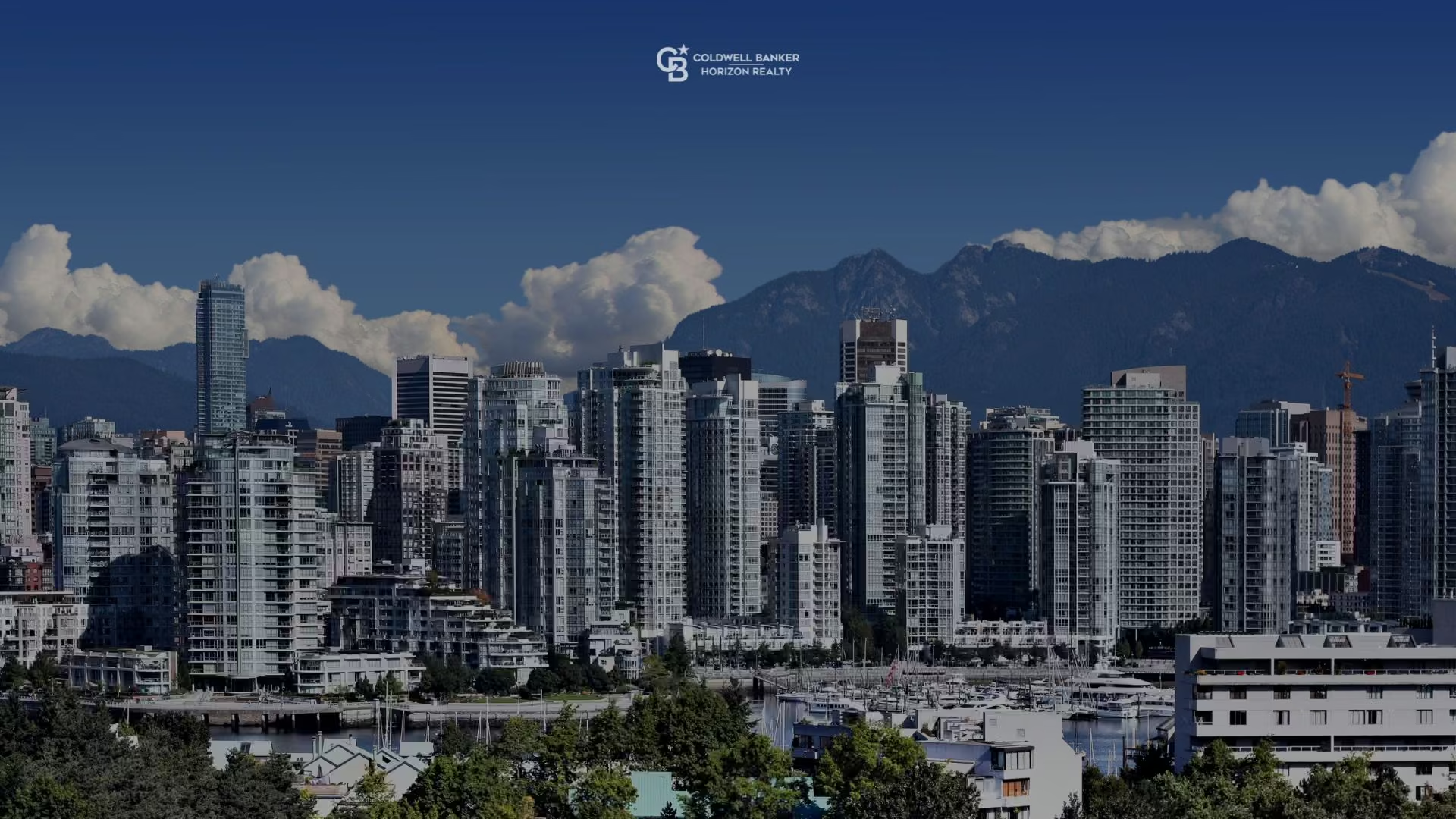
January was brutal for Vancouver real estate. Not just slow. Brutal.
Sales fell roughly 29% compared to last year. New listings surged past 5,100 properties, pushing active inventory to around 12,600 homes. For a market Vancouver's size, that's a lot of unsold real estate sitting around.
Compare that to Toronto. The GTA is more than twice as large, yet it only has about 18,000 active listings right now. Do the math on sales-to-inventory ratios and Vancouver's problem becomes clear: there are way more homes for sale than people willing to buy them.
This isn't just a seasonal blip. Something fundamental has shifted.
The Inventory Imbalance
Metro Vancouver recorded about 1,107 sales in January against those 12,600 active listings. That works out to roughly 11 months of inventory across the market. For detached homes specifically? Nearly 15 months.
Toronto's sitting at about 5.6 months of inventory. Still a buyer's market by traditional measures, but nowhere near Vancouver's glut.
What does 11 to 15 months of inventory actually mean? It means if not a single new home hit the market tomorrow, it would take nearly a year to clear current supply at the current sales pace. That's not a correction. That's a fundamental breakdown in market dynamics.
Three years ago, Vancouver properties moved in days. Buyers competed. Sellers had leverage. Now homes sit for months while prices drift lower and sellers wonder if they should cut the asking price again or just wait it out.
When Lower Rates Don't Matter
Mortgage rates have dropped. Three-year fixed rates are running around 3.5%, and five-year terms are available near 4% if you qualify well and shop around.
Normally, that kind of rate relief would bring buyers back. It hasn't.
Why? Because people who watched Vancouver prices climb to absurd heights also watched them fall. They saw friends buy in 2021 or 2022, stretching budgets to the limit, only to end up underwater on their mortgages within two years. They're not rushing back in just because borrowing got cheaper.
The million or so Canadian households facing mortgage renewals this year are mostly just relieved they won't get destroyed by higher payments. They're not thinking about buying a second property or upgrading to something bigger. They're thinking about surviving.
The Affordability Gap That Never Closed
Vancouver's benchmark home price sits around $1.1 million. Toronto recently slipped below $1 million. But price alone doesn't tell the story.
Vancouver incomes lag Toronto's. Significantly. Toronto has a massive financial sector, a substantial auto industry presence in the broader region, and diversified corporate head offices. Vancouver's economy leans heavily on real estate, tourism, film production, and tech.
Those are fine industries. But they don't generate the same density of high-paying jobs that Toronto's economy does. And when you combine lower incomes with higher prices, you get a market that's fundamentally out of balance.
RBC and other analysts have consistently ranked Vancouver as Canada's least affordable major housing market. Not just expensive. Unaffordable. There's a difference.
The Policy Layer That Didn't Fix Anything
Both Vancouver and Toronto implemented foreign buyer taxes. Both added vacancy penalties. Both have massive immigrant populations (42% of Vancouver residents and 46% of Torontonians were born outside Canada).
The taxes were supposed to cool speculation. They didn't really work. Prices kept climbing until broader economic forces and rising interest rates finally broke the cycle.
Now we're watching what happens when speculative momentum dies and fundamentals reassert themselves. Turns out, homes need buyers who can actually afford them. When that equation doesn't work, the market freezes.
What RBC's Economist Is Seeing
Rachel Battaglia at RBC summed up January's numbers plainly: demand collapsed in Vancouver and the Fraser Valley, with Edmonton, Winnipeg, and Saskatoon also posting weak results. Toronto and Montreal continued softening.
Notice Vancouver led that list. Not because it's the only struggling market. But because the drop-off there has been sharper and faster than almost anywhere else.
Calgary and Regina? They're seeing increased activity. Buyers are moving toward affordability and job markets that actually function. That's not Vancouver right now.
The Listing Treadmill
Here's something most buyers don't realize about those "days on market" numbers: they reset every time a listing gets pulled and relisted.
Drop your price by $75,000 and relist? The counter goes back to zero. Cancel the listing for a week then repost it? Zero again.
The real number is CDOM (cumulative days on market) or PDOM (property days on market). That tracks actual time for sale, not just time since the latest desperate adjustment. Those numbers aren't always public, but they tell the real story of how long sellers are struggling to move properties.
In Vancouver right now, homes are sitting for months. Sellers stage perfectly. Keep the place spotless for showings. Adjust prices. And still nothing moves.
The Excess That Built This
You can't understand Vancouver's current situation without acknowledging the absurdity that came before.
This was a market where literal teardowns in decent neighborhoods sold for millions. Where speculation ran so hot that basic economic logic stopped applying. Where people bought not because they needed housing but because they assumed prices would keep climbing forever.
The BC government tried to intervene with taxes. Vancouver added vacancy penalties. None of it addressed the core problem: a market completely detached from what regular people with regular jobs could afford.
Now the market's correcting itself. And corrections don't care about what you paid or what you think your home should be worth.
What Happens Next
If there's a major price correction still coming in Canada, Vancouver's where it'll hit hardest.
The fundamentals are all wrong. Massive inventory. Weak demand. Prices still disconnected from local incomes despite recent drops. And a collective loss of confidence that values will recover quickly.
Toronto will probably keep grinding lower too. But Vancouver's fall could be steeper. The market was more overheated to begin with, and now it's deeper into buyer's market territory than any other major Canadian city.
The people who should worry most? Anyone who bought in the last three years assuming prices would stabilize. Anyone who needs to sell in the next year. Anyone still holding onto the belief that Vancouver real estate is special and exempt from normal market forces.
It's not. The numbers prove it. And watching a market this size unwind in real time is unsettling, even if you saw it coming
The content of this article is for informational purposes only and should not be considered as financial, legal, or professional advice. Coldwell Banker Horizon Realty makes no representations as to the accuracy, completeness, or suitability of the information provided. Readers are encouraged to consult with qualified professionals regarding their specific real estate, financial, and legal circumstances. The views expressed in this article may not necessarily reflect the views of Coldwell Banker Horizon Realty or its agents. Real estate market conditions and government policies may change, and readers should verify the latest updates with appropriate professionals.