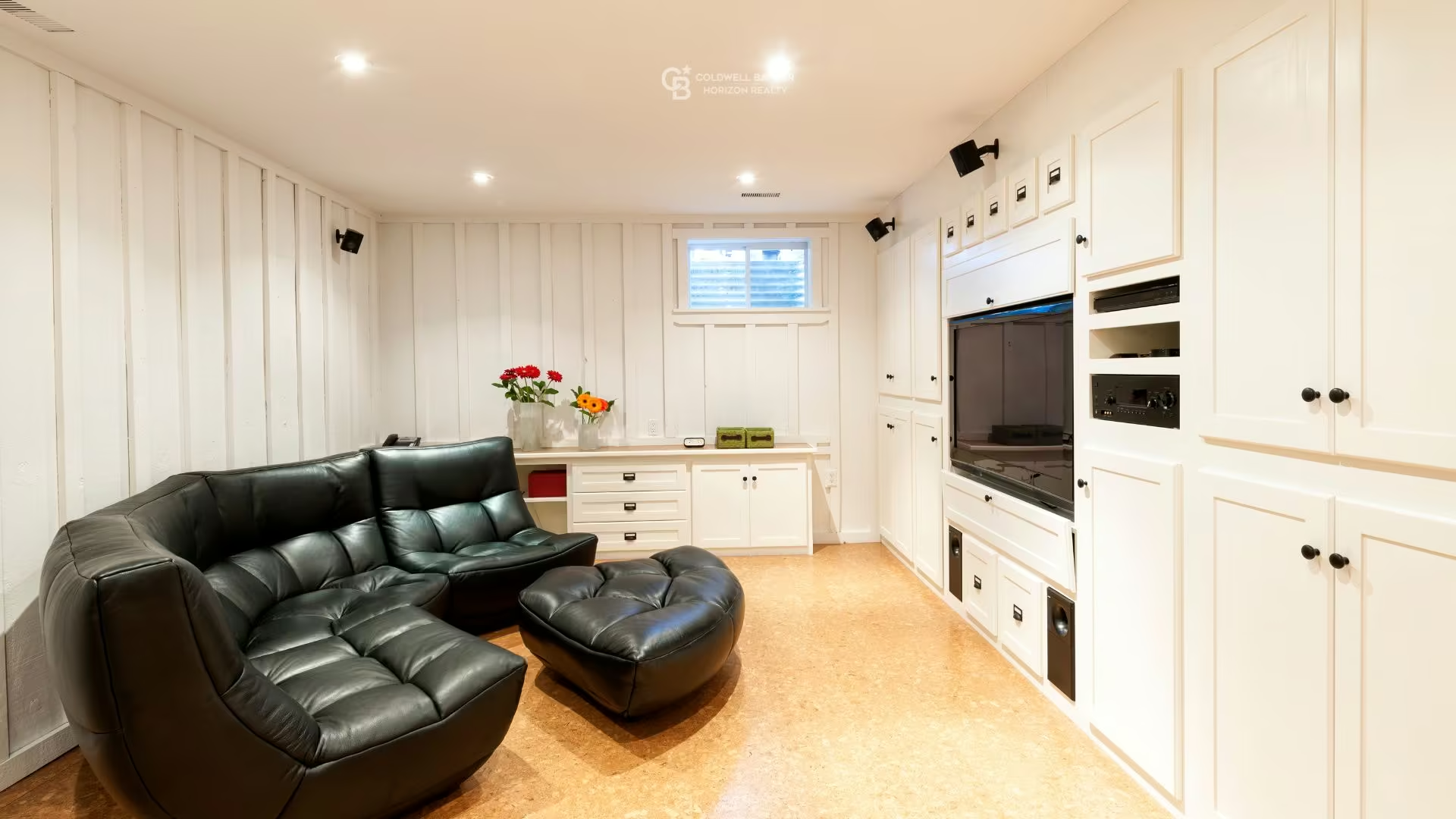
Tens of thousands of Canadians sleep each night in basement apartments that officially don't exist. Possibly far more.
Not on city registries. Not on safety inspections. Not on insurance policies. These are the invisible apartments where international students cram textbooks under low ceilings, where new immigrants save for something better, where single parents stretch paychecks that won't cover anything else.
No one knows exactly how many people live in illegal or unauthorized basement suites across Canada. Cities don't track what they can't see. Both landlords and tenants have reasons to stay quiet. But the available snapshots suggest the scale is massive.
This isn't some fringe housing problem. It's how housing actually works in Canada's major cities, operating in plain sight while everyone pretends not to notice.
The Numbers Cities Don't Want to Talk About
The real estate industry has estimates that should make policymakers uncomfortable.
In the Greater Toronto Area, roughly 80% of basement apartments may be operating without full legal compliance, according to industry sources. Over in Greater Vancouver, real estate and legal experts suggest around 80% of secondary suites don't meet all regulatory requirements. These are estimates, not official census figures. But even if they're off by half, you're still looking at tens of thousands of units.
Calgary has over 11,000 registered secondary suites as of late 2023. City officials openly acknowledge there are "many more" operating without registration. Some estimates suggest over half of Calgary's basement suites may contravene regulations.
Put differently: in Canada's biggest housing markets, the illegal suite market likely dwarfs the legal one.
Vancouver's Open Secret
Vancouver leads the country, but not in a way worth celebrating.
The city officially recognizes over 15,586 unauthorized suites, though this conservative count likely captures only the basement apartments visible enough to notice. A 2015 Square One Insurance study examining 4,000 policyholders found 43% of Vancouver homeowners had secondary suites, compared to a 14% average across other Canadian cities.
Square One noted these numbers were probably low. People with illegal suites tend not to advertise them to their insurers. For obvious reasons.
Toronto follows similar patterns. Real estate industry sources estimate roughly 80% of GTA basement apartments operate outside legal frameworks, though the city doesn't publish official illegality rates. If accurate, you're talking about tens of thousands of units where electrical systems weren't inspected, where egress windows don't meet fire code, where carbon monoxide detectors may or may not exist.
Calgary presents its own version of the problem. The city received approximately 2,500 complaints regarding secondary suites between 2020 and 2022. Building safety manager Cliff de Jong knows there are "still thousands of existing illegal suites out there."
What's striking isn't just the size of these numbers. It's their persistence. Vancouver started allowing secondary suites citywide in 2004. Toronto has encouraged basement apartments for over a decade. Calgary runs amnesty programs. Yet the illegal suite market continues to dwarf the legal one.
When "Illegal" Actually Means Dangerous
The word "illegal" sounds dramatic, but most illegal basement suites aren't deliberately dangerous. They're just not officially allowed to exist.
A suite becomes illegal through various pathways. Sometimes it was built without permits. Sometimes it lacks required safety features like proper egress windows, interconnected smoke alarms, or fire separation between units. Sometimes it meets safety codes but the property isn't zoned to allow secondary suites at all.
The distinction matters because illegal suites exist on a spectrum. Some are perfectly maintained spaces that simply lack city approval. Others? Not so much.
When Calgary conducted a safety blitz in 2012 examining 50 illegal suites, 80% had major safety issues, according to city inspection reports. De Jong noted something more concerning: "Worse yet, owners didn't even know what we were talking about when we were talking about life safety."
This was a targeted sample, not a random survey. Inspectors likely focused on units already suspected of problems. But the findings illustrate what can accumulate when renovations happen without oversight.
Common violations tell you what's being ignored:
Bedroom windows too small to escape through during fires. Missing or non-functioning smoke detectors. Inadequate ceiling heights causing long-term health problems. Single exits creating death traps. Electrical systems overloaded beyond capacity. No fire separation between basement and main floor. Black mold from poor ventilation. Security bars on windows, turning bedrooms into cells.
The Deaths That Prove It's Not Theoretical
Fatal fires in illegal or poorly maintained suites don't represent the majority of residential fire deaths. But they demonstrate what happens when safety codes are ignored.
In 2010, three people died in a basement suite fire in northwest Calgary. Fire officials noted security bars on windows and a smoke detector that wasn't working properly.
In 2013, 24-year-old Alisha Lamers died in an illegal Toronto rooming house fire. The Fire Marshal's investigation found the structure "lacked adequate fire separations, means of egress and smoke alarms." Lamers suffered extensive burns over 55% of her body before dying of brain death from oxygen deprivation. Her basement suite had bars on the windows. Just one exit, when the law requires at least two. Investigators never recovered a smoke alarm from the basement debris.
Her parents had to plan a funeral for a 24-year-old. "Her future was snuffed out," her mother said.
Between 2013 and 2017, fires occurred at 69 illegal rooming houses in the Toronto area. Toronto Fire Service Deputy Fire Chief Larry Cocco has seen "upwards of 27, 28 individuals in a rooming house at one time."
The broader statistics provide context: approximately 220 people die in fires annually in Canada, with 81% classified as unintentional. Of these, 92% occur in residential fires. Critically, at least 14% of residential fire deaths involved non-functioning smoke alarms, though smoke alarm status was unknown in many cases. The actual percentage could be higher.
The data doesn't isolate how many deaths occur specifically in illegal suites. But the cases above illustrate the life-or-death importance of proper fire separation, working smoke detectors, and adequate escape routes. Exactly the features that illegal suites often lack.
Why Landlords Roll the Dice
The landlord calculus isn't complicated. Renting an illegal suite generates income immediately. Legalizing it costs tens of thousands of dollars and months of bureaucratic navigation.
The financial pressure starts with housing costs themselves. The Square One Insurance study found that the number one reason homeowners create secondary suites is "to help them fund their mortgage with the high cost of real estate." In markets where detached homes cost seven or eight figures, the monthly mortgage payment can exceed what many households earn.
Secondary suites offer what mortgage brokers call "mortgage helpers." Rental income that can make the difference between affording a home or not.
For buyers, many lenders will consider up to 100% of rental income from legal secondary suites when qualifying for mortgages, though specific treatment varies by lender and insurer. This can dramatically increase buying power. But income from illegal suites typically doesn't count toward mortgage qualification, or is heavily discounted.
For existing homeowners, a basement suite can generate $1,500 to $2,000 monthly. That's $18,000 to $24,000 annually. Often the difference between keeping a home or losing it.
But legalizing a suite costs serious money. Contractors and media reports suggest that in Calgary, converting an illegal basement to legal status can cost $40,000 to $70,000, with Toronto homeowners facing similar ranges. These costs include:
Separate heating and ventilation systems. Fire-rated drywall and proper fire separation. Code-compliant egress windows. Separate electrical panels. Additional parking spaces. Separate entrances. Building permits and inspection fees.
Calgary contractor Bo Fric, who specialized in basement developments from 2011 to 2017, watched the economics kill his business. With personal renovations, his company quoted three clients for every job secured. For basement suites, that ratio became 70 or 80 quotes for every single job. Clients were "so shocked at the pricing."
It just became totally unmanageable as a business, Fric said. "We were just burning way too much money quoting these jobs."
Andrew Leslie of Solid Solutions Calgary reports that in his experience, only about 5% of clients move forward with legal suite development after learning about the process and cost. While this reflects one contractor's experience rather than citywide data, it signals how cost and complexity deter legalization.
The regulatory maze compounds the financial burden. Fric describes the permit process as "long, unpredictable, challenging." Dawn, a Calgary homeowner CBC profiled, contacted six contractors about legalizing her basement suite. Three of them outright refused to take on the job because of city regulations.
She ultimately decided to rent out the illegal suite anyway. To help others who need a home, she said.
Many homeowners don't realize their suite is illegal. They purchased homes with existing basement apartments and assumed everything was above board. Others hire contractors who build without permits to save money, then discover the problem years later when they try to sell or when a tenant complains.
The insurance risk creates another pressure point. Standard homeowner policies typically don't cover illegal rental units. If fire or flood damages an illegal suite, insurance companies can deny claims entirely. Yet disclosing the suite often means higher premiums or policy cancellations. So homeowners stay quiet and hope nothing goes wrong.
Why Tenants Take the Risk
Tenants make a different calculation. They're weighing safety against a more immediate threat: having nowhere to live at all.
Affordability drives most decisions. Illegal basement suites often rent for less than legal apartments. While systematic comparative data is scarce, landlord guides and rental market observers suggest the discount in Vancouver or Toronto might run several hundred dollars monthly. Potentially $600-$800 or more. For many renters, that's the difference between financial survival and complete impossibility.
New immigrants and international students face particular pressure. They often need housing immediately, lack local references or credit history, and have limited rental budgets. Illegal suites don't always ask for credit checks or employment verification. Cash transactions happen. Questions go unasked.
"For many who cannot keep up with ever-rising housing costs, turning to more affordable options, like basement apartments, is their best option," explains one housing analysis. "On the flip side, the crisis has given many homeowners with basements the opportunity to provide affordable housing by renting out their basements and increasing their household income."
Many tenants simply don't know they're in illegal suites. The apartment has a kitchen, bathroom, separate entrance. It looks like a regular rental. Unless you know to check ceiling heights, window sizes, smoke alarm types, the red flags aren't obvious.
Even tenants who suspect problems face difficult choices. William Allen, who lived in several illegal Calgary suites, described them as "like bunkers, just not designed for human habitation". His rentals featured broken smoke detectors, small egress windows, low support beams creating "head injury hazards," black mold, beetles.
Yet Allen and others like him stayed. Because alternatives either didn't exist or cost too much.
The tight rental market eliminates options. Calgary's rental market has been tight for years. Toronto and Vancouver's vacancy rates hover near 1%. When dozens of people compete for every legal rental, the illegal suites become default housing for people priced out of everything else.
There's also a knowledge gap. Many tenants, particularly newcomers, don't understand Canadian building codes or their legal rights. They trust that if someone is renting a space, it must be legal. The unspoken agreement between landlord and tenant, both benefiting from an arrangement neither wants to publicize, creates mutual silence.
The Catch-22 of Enforcement
The relationship between illegal suites and the law creates strange contradictions.
Tenant protection laws apply even in illegal suites. In Ontario and BC, the Residential Tenancy Act covers all rental arrangements, legal or not. Landlords must maintain habitability standards. Tenants must pay rent and avoid damage. The suite's legal status doesn't void these obligations.
Yet the protections come with a catch. If a tenant complains about conditions and triggers an inspection, the resulting enforcement action might force them to vacate. Jonathan Fox, director of the Tenants Rights Unit at the New York Legal Assistance Group, describes the problem: "If a tenant doesn't inform city authorities, it's very unlikely the landlord will make changes to the apartment to make it more habitable".
Enforcement itself varies wildly. Vancouver, Calgary, and Toronto all have inspection teams investigating illegal suite complaints. But resources are limited. Inspections typically happen only after specific complaints. Most illegal suites operate for years without official notice.
When cities do enforce, the consequences fall hardest on tenants. Landlords face fines. Tenants lose housing. In Toronto, if a city inspection deems a suite illegal and uninhabitable, tenants may be forced to leave. The city may offer relocation assistance, but finding new affordable housing remains the tenant's problem.
Calgary's Experiment With Amnesty
Some municipalities are trying different approaches. Calgary extended its Secondary Suite Amnesty Program until December 31, 2026. Under this program, the city forgoes enforcement against illegal suite landlords who agree to either shut down their suites or bring them up to current safety codes. The city also waives all related fees during the amnesty.
Since the program started in 2018, more than 10,000 secondary suites have been added to Calgary's registry. The registry now lists over 11,000 legal, safe suites as of late 2023. City documents indicate almost 90% of the current registry was added during the amnesty period.
That's real progress. Ten thousand fewer fire traps. Ten thousand fewer situations where a broken smoke alarm could mean death.
But councilors debate whether the amnesty should continue. Some argue the leniency discourages compliance. "There's a lot of folks right now that are like, 'nobody's enforcing it,'" said Councilor Andre Chabot. "But if they knew that somewhere down the road that is was going to be enforced and there are reduced requirements today, it might actually push some people to move forward."
The Legalization Efforts That Aren't Quite Working
Canadian cities have recognized that criminalizing basement suites doesn't make them disappear. It just makes them more dangerous.
Vancouver allowed secondary suites citywide beginning in March 2004, making it possible for every single-family house to have a secondary suite. The changes reduced requirements. One on-site parking space became acceptable for pre-2004 houses. Ceiling height requirements dropped to 6'6" over 80% of the suite area. Partial sprinkler systems were no longer mandatory for existing homes.
Toronto similarly loosened restrictions. The city allows one secondary suite per detached or semi-detached house, provided the property is at least five years old and the suite occupies a smaller area than the main residence.
Calgary has worked to streamline approvals, implementing Land Use Bylaw changes in 2021 that eliminated discretionary review requirements and reduced complexity and costs. The city now offers up to $10,000 through the Secondary Suite Incentive Program to cover safety-related costs of building secondary suites to code.
Yet legalization remains uncommon. Despite amnesty programs, financial incentives, and simplified regulations, most illegal suites stay illegal.
The cost barrier remains formidable. Even with a $10,000 incentive, homeowners still face $30,000 to $60,000 in remaining costs. For homeowners already stretched financially, this represents years of the rental income they're trying to generate.
The regulatory complexity deters people even when financial help exists. Homeowners need to confirm zoning allows secondary suites in their area, apply for development permits and building permits, hire licensed contractors and engineers, navigate fire code and electrical code and plumbing code requirements, schedule multiple inspections at different construction stages, then wait for final approval and registration.
Each step creates delays and uncertainty. Fric noted the permit process takes approximately five hours just to generate a quote. The actual approval process stretches months.
Many contractors refuse basement suite work entirely due to regulatory headaches. When Dawn approached contractors in Calgary, half refused the job outright.
Some homeowners discover their properties can't be legalized at all. Ceiling heights may be too low to raise, requiring foundation lowering that costs more than the home's value. Properties in neighborhoods not zoned for secondary suites need rezoning approval that neighbors often oppose. Older homes may need complete electrical and plumbing system replacements.
The programs that do exist have limited reach. Toronto's amnesty program reached only certain neighborhoods. Vancouver's legalization process, while available citywide, still requires homeowners to navigate substantial paperwork and costs. Calgary's $10,000 incentive helps but doesn't eliminate the financial barrier.
What these programs accomplish is incremental progress. Calgary's amnesty has moved 10,000 suites from completely unregulated to registered and inspected. That matters.
But the fundamental tension remains. Making suites legal costs money and time that neither landlords nor tenants have. The housing crisis creates irresistible pressure to create more units by any means available.
What This Means for the Actual Housing Market
The shadow rental market isn't separate from the legal housing market. It's holding up a significant portion of it.
The scale is difficult to quantify precisely, but consider the implications. If Vancouver's estimated 15,000+ unauthorized suites suddenly disappeared, where would those tenants go? If Toronto's thousands of illegal basement apartments closed overnight, what would happen to rental demand? If even a conservative portion of these units house people who couldn't otherwise afford market-rate apartments, the displacement would be measured in tens of thousands across major Canadian cities.
This creates strange incentives. Cities need these illegal suites to prevent homelessness, so enforcement remains selective. Landlords need the income, so they keep quiet and hope no one complains. Tenants need affordable housing, so they accept risks they might not if they had alternatives.
Legal basement suites do add property value. Homes with authorized secondary suites typically sell for more than comparable houses without them. The additional income stream attracts buyers looking for mortgage helpers or investment opportunities. Legal suites also mean homeowners can access refinancing based on rental income, creating financial flexibility.
But illegal suites create the opposite effect. During home sales, illegal suites must either be disclosed (reducing the purchase price), legalized (costing tens of thousands), or converted back to single-family use (eliminating the income and often requiring kitchen removal). Buyers using rental income to qualify for mortgages find lenders won't recognize income from illegal suites.
The insurance complications create additional market friction. Homeowners with undisclosed illegal suites risk having claims denied if disasters occur. Some discover this only after fires or floods, when insurance adjusters investigate and find unauthorized renovations void the policy.
The existence of illegal suites may also affect legal rental markets by influencing rental rates. When thousands of below-code units operate at lower costs (no compliance expenses, potentially reduced property tax assessments), basic economic logic suggests they could put downward pressure on rents, particularly at the lower end of the market. This dynamic, while difficult to measure precisely, could theoretically make developing legal rental housing less profitable. It reduces the incentive to build the legitimate supply that might actually address affordability issues. However, quantifying this effect requires data that doesn't exist in most markets.
The Way Forward (If There Is One)
No one has figured out how to make this problem go away.
Cities could enforce strictly, inspecting every basement suite and shutting down illegal units. This would protect safety but create a homelessness crisis overnight. Thousands of tenants would need housing that doesn't exist. Thousands of homeowners would lose mortgage-helper income they depend on.
Alternatively, cities could fully amnesty existing suites, grandfathering everything currently operating. This would acknowledge reality but accept that tens of thousands of people live in spaces that don't meet modern safety codes. The next fire would raise questions about why no one acted.
The middle path, what most cities currently attempt, involves incentive programs, amnesty periods, simplified regulations, and selective enforcement. Progress happens gradually. Some suites get legalized. Some landlords install proper fire separation and egress windows. But the fundamental economics don't change. Making suites legal costs more money than most people have.
What would actually help? Larger financial incentives. $10,000 doesn't cover $50,000 in renovations. Longer amnesty periods, giving homeowners time to save for upgrades. Grandfathering provisions for suites meeting basic safety even if they don't meet every code requirement. Streamlined permitting that takes weeks instead of months. Public databases showing which suites are registered, making it easy for tenants to verify before renting. Mandatory disclosure requirements for home sales, so buyers know what they're getting.
But even perfect policy won't solve the core problem. Canada doesn't build enough housing to meet demand, so people improvise. They carve apartments out of basements, garages, attics. Wherever space exists. Some of these improvisations are safe. Many are not. But when the alternative is sleeping in a car or a shelter, people accept risk.
The illegal basement suite market will continue existing as long as housing shortages persist and legalization remains expensive and complicated. The amnesty programs and incentives help at the margins. They've moved thousands of suites from completely unregulated to registered and inspected.
That's progress, even if it's not a solution.
The People This Is Actually About
But for the tens of thousands of Canadians sleeping tonight in basements that technically don't exist (at minimum, and quite possibly far more), the policy debates matter less than immediate questions. Does the smoke detector work? Do the windows open wide enough to escape through? Did the landlord actually install proper fire separation or just claim they did?
The shadow rental market operates on trust and hope. Trust that the space is safe. Hope that nothing goes wrong. Most of the time, nothing does. But when fires start, when carbon monoxide accumulates, when disasters happen, the illegal status of a suite transforms from an administrative detail into a potential death sentence.
Cities know about these suites. Landlords know they're renting them. Tenants know they're living in them. No one knows exactly how many exist, but everyone understands the scale is substantial. And everyone hopes that the statistics on fire deaths and safety violations stay statistics. Numbers on a page rather than names in obituaries.
That's the real story of illegal basement suites in Canada. Not policy failures or regulatory complexity. Thousands upon thousands of people making rational decisions in an irrational housing market. Weighing known risks against the certainty of having nowhere else to go.
Alisha Lamers was 24 when she died in that basement fire. Her parents had to make funeral arrangements for a daughter who "had her whole life in front of her."
That's what's actually at stake here. Not compliance rates or registration numbers. Lives.
The content of this article is for informational purposes only and should not be considered as financial, legal, or professional advice. Coldwell Banker Horizon Realty makes no representations as to the accuracy, completeness, or suitability of the information provided. Readers are encouraged to consult with qualified professionals regarding their specific real estate, financial, and legal circumstances. The views expressed in this article may not necessarily reflect the views of Coldwell Banker Horizon Realty or its agents. Real estate market conditions and government policies may change, and readers should verify the latest updates with appropriate professionals.